

Introduction
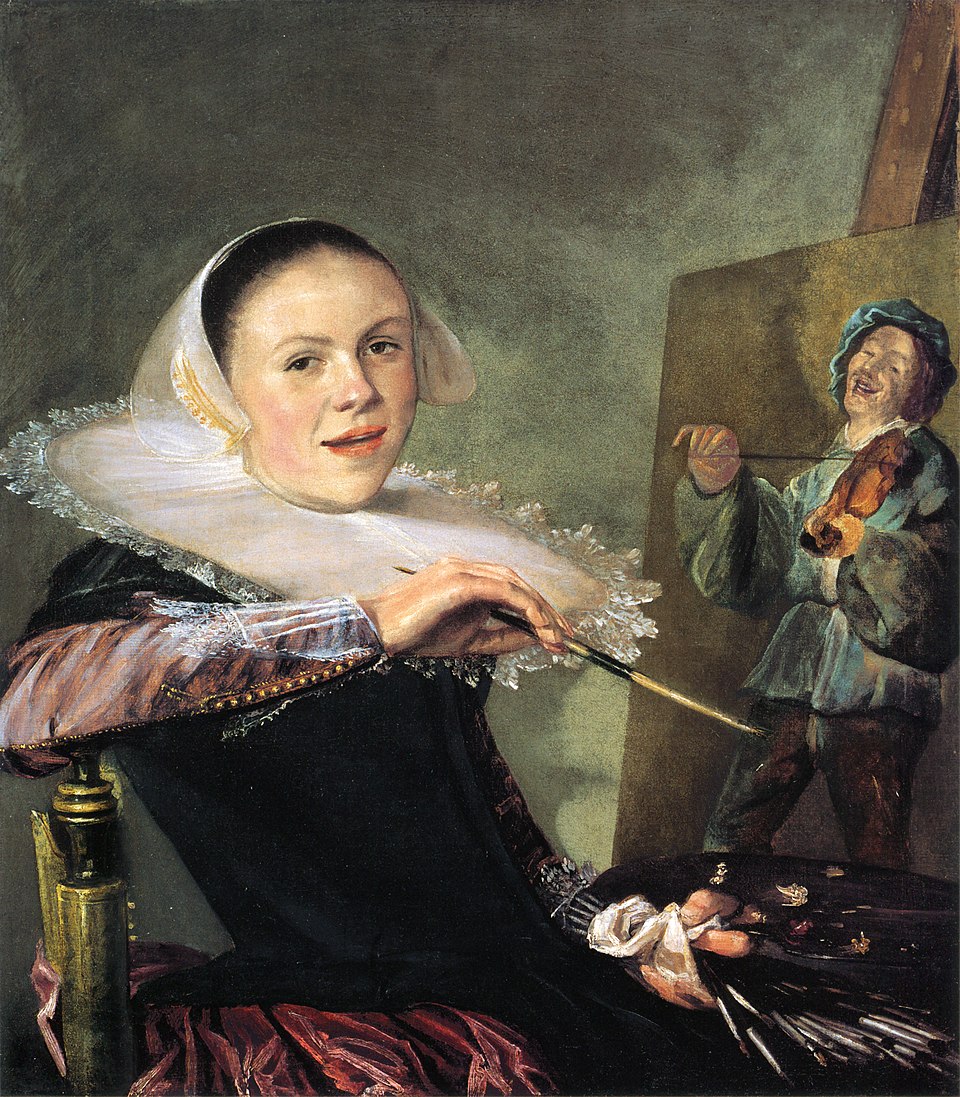
I marveled at the fine barbs of the feather; the soft blending of the fabric folds; the ruddy cheeks complementing the greenish-blue tunic; the movement of the beret, which seemed in danger of slipping to the floor at any moment. Judith Leyster’s skill as a seventeenth-century Dutch master painter is evident in the captivating and technically impressive The Jolly Drinker. The piece is complete with the date it was created, 1629, and the signature “JL.” Yet, these initials were not discovered until 1893–over two centuries after Leyster’s death–before which the painting was attributed to her contemporary Frans Hals. In fact, Hals received credit for the entirety of her works due to their similar artistic styles. Upon hearing of this egregious error, my mother asked our guide how it could have occurred when the signature is conspicuous to the naked eye. He responded that we often do not see what we do not want to believe. Perpetuating the misconception that “artistic master” was a title exclusively for men, popular male artists and critics considered women incapable of producing masterpieces and did not believe they should do so.

Unfortunately, Leyster is not the only Dutch female artist who has been subject to these inequities; there are few surviving records of many such figures, and their works are frequently misattributed. How could the multitude of female artists who contributed to the Dutch Golden Age, during which the art world flourished alongside numerous other spheres of Dutch society, be simply . . . forgotten?
The Lack of Documentation
One contributing factor is that since some female artists were taught by their fathers so that they could partake in family businesses, these men have been credited for their daughters’ creations. Yet, as mentioned, the works of artists such as Leyster were not misattributed to a teacher or relative, so a more likely explanation is that few influential eighteenth-century biographers wrote about Dutch female artists. For instance, Arnold Houbraken, Jacob Campo Weyerman, and Johan van Gool have had a considerable impact on whether and how artists within the Dutch Republic are remembered, but they rarely recorded women’s lives. Since their texts were often used by nineteenth-century historians, for example, as windows into the lives of seventeenth-century artists, this lack of documentation has contributed to the waning memory of Dutch female artists after the Golden Age.
Studying the texts that these biographers did publish about women illuminates their problematic perception of the gender. Both Houbraken and Weyerman wrote often and positively about the works of painter Maria van Oosterwijck. Her pieces feature religious undertones as well as themes of the transience of life and worthlessness of material pleasures, which are characteristic of vanitas, a seventeenth-century genre of Dutch master paintings that was encouraged by the Protestant Reformation. Her devotion to art and religion likely were the sole reasons that Houbraken and Weyerman viewed van Oosterwijck as worth writing about. Just as unfortunate is the fact that Houbraken and van Gool documented Dutch painter Rachel Ruysh’s life only within the context of her male relatives. Specifically, Houbraken wrote about her grandfather and his brother while van Gool about Ruysch’s husband, Juriaen Pool, although he experienced considerably less commercial success than Ruysch. (In fact, Ruysch’s commercial success exceeded that of iconic artists such as Rembrandt Harmenszoon van Rijn, whose decline in prosperity is described here.) These biographers’ intentional avoidance of providing Dutch female artists with the documentation and individual identities, separate from their male counterparts, that they deserved demonstrates the bias that has historically existed against women in the artistic world. Moreover, this legacy has led to unintentional misattribution fueled by insufficient knowledge about female artists and by unconscious sexism.

Vanitas with Sunflower and Jewelry Box by Oosterwijck, circa 1665 (https://commons.wikimedia.org/wiki/File:Vanitas_Still_Life_with_a_Sun_Flower_by_Maria_van_Oosterwijck_Rijksmuseum_Amsterdam_SK-A-5104.jpg) 
Vanitas Still-life by Oosterwijck, 1668 (https://commons.wikimedia.org/wiki/File:Vanitas-Still_Life,_Oosterwijck.jpg) 
Flower Still Life by Oosterwijck, 1669 (https://commons.wikimedia.org/wiki/File:Maria_van_Oosterwijck_-_Flower_Still_Life_-_Google_Art_Project.jpg) 
Spray of Flowers with Insects and Butterflies on a Marble Slab by Ruysch, 1690 (https://commons.wikimedia.org/wiki/File:Rachel_Ruysch_-_Spray_of_flowers_with_insects_and_butterflies_on_a_marble_slab_-_1690s_-_PD.38-1975.jpg) 
Flowers in a Glass Vase, with a Cricket in a Niche by Ruysch, 1700 (https://www.wikiart.org/en/rachel-ruysch/flowers-in-a-glass-vase-with-a-cricket-in-a-niche-1700) 
Flowers in a Glass Vase by Ruysch, 1704 (https://commons.wikimedia.org/wiki/File:Rachel_Ruysch_-_Flowers_in_a_vase_on_a_stone_slab_-_1704_-1995.67.jpg)
The Cognitive Psychology behind Unconscious Sexism
The Benefits and Shortcomings of Our Memory
While I am not arguing that the tendency to attribute masterpieces by female artists to men can be boiled down to the following cognitive psychological processes, I do wonder what they can contribute to our discussion of unconscious sexism. Before we delve into the role memory plays in unconscious sexism and other forms of discrimination, I want to establish that it is nevertheless critical to humans’ adaptation and survival. Authors Hannah Rasmussen and Mia Tenditnyy of “How the Work of Memory is Biased: A Look at Sexism from Cognitive Psychology” provide the example of our hominin ancestors’ need to remember which berries were non-poisonous, which animals would attack, and more broadly, how to navigate their environments. Due to the importance of recalling the past to help our future selves, this process has become so entrenched in our nature that it occurs almost instantaneously and unintentionally. Therefore, humans are constantly and efficiently pattern-matching, or recognizing the connection between entering stimuli and the sensory information stored in their memory to categorize the former.
Despite the immense benefits of memory and the essential role recollection of past experiences, interactions, and thoughts plays in molding our cultural beliefs, such beliefs can spawn sexist ones. Moreover, pattern-matching can engender stereotyping. Are you starting to see how our mental processes can contribute to unconscious sexism?
An Overview of Schematization
To develop a deeper understanding, let’s explore a critical predisposition of our human brains: engaging in schematization–or constructing generalizations that help us make sense of the world around us–rather than recalling information with complete accuracy. Schemas assist in organizing stored knowledge into categories that we can use to understand information we intake in the future, and culture shapes the schemas we use to comprehend our lives. For instance, what types of food do you associate with New Year’s? Your answer, whether it be the rice cakes that sometimes usher in Chinese New Year or the tamales that are traditionally eaten on New Year’s in Mexico, depends on the schema you have developed around this occasion due to the culture(s) to which you have been exposed.

But, on a deeper neurological level, how are schemas developed and remembered? Their formation involves cell assemblies, which are interconnected groups of neurons; specifically, the neurons are connected by synapses, which are small gaps across which they can transmit chemical signals. When one neuron sends such a signal to another, the latter will potentially fire. There is a higher likelihood that this firing will occur amongst neurons within a cell assembly because their synaptic connections with each other are stronger than the ones they share with neurons outside the group. For instance, if a part of a cell assembly is excited when a person sees part of an object, that section causes the entire group of neurons to fire, so the perceiver recognizes what the object is in its entirety. When you see–or learn or experience–something, neurons activate together to form cell assemblies, and when you successfully recall the information or experience, the same ones are reactivated.

The Dangers of Schematization
Are you wondering how this process leads to generalized rather than completely accurate memories? Well, the stronger the synaptic connections between neurons within cell assemblies, the more likely the memories represented by those assemblies are to be retrieved. These stronger connections are formed when information from old and new sensory input overlaps because neurons are repeatedly fired, and as a result, generalized versions of memories are created while unique aspects of the specific stimuli are forgotten. Due to the creation of schemas, new sensory information can be more efficiently converted into a form capable of storage and retrieval if it aligns with knowledge that is already stored; therefore, sensory input can be forced into alignment with old schemas. Our minds further generalize information by producing prototypes from schemas. A prototype is the most typical or ideal example of a concept categorized as fitting within a given schema, and stronger ones often cause cultural beliefs to be reinforced by encouraging us to view new sensory information as in agreement with our current ideologies. Due to our brains’ predilection for connecting new with stored information, when we confront someone or something that conflicts with our beliefs, we experience a type of mental discomfort called cognitive dissonance. Potentially for this reason, gender stereotypes and overall sexist beliefs become ingrained in our minds when we continually encounter them in our environments and cultures–whether as a consequence of intergenerational transmission of sexist ideals during formative years or exposure to them in current societies.

How to Counter Unconscious Sexism
You may be asking yourself, “If sexism is entrenched in me by cognitive processes, how do I have control over preventing myself from practicing it unconsciously? How do I recognize women’s literal and figurative signatures on their intellectual property rather than continuing a history of misattribution?” These concerns are understandable. After all, looking beyond the indirect role memory plays in misattribution via its encouragement of stereotyping, for instance, American psychologist Daniel Schacter underscored the direct relationship between the two. He deemed mental misattribution–mistakenly associating what may be an accurate memory with an incorrect source, whether that be a time, place, or person–one of the seven “sins” of memory. While there are dangers of schematization as a whole, such sins exacerbate the problem by falsifying our schemas about women.
Regarding my response to the questions you may or may not have, I would recommend reading my post “The Dangers of Genetic and Biological Determinism,” in which I discuss the risks of using the evolutionary purposes behind behaviors, such as male sexual jealousy, to justify inexcusable actions, such as domestic violence. As this post reiterates, just because our biology predisposes us to harmful behaviors does not mean we cannot combat them by changing our cultural and individual practices.
In fact, while our brains’ problematic tendencies may seem discouraging to those seeking to practice anti-sexism, Rasmussen and Tenditnyy assert that, according to cognitive science, “our minds are quite flexible.” Rather than striving for solely accuracy as computers do, our minds, due to their flexibility, enable viewing information in new ways and changing thinking patterns, both of which can help us combat our sexist beliefs. While I do not claim to hold the solution to demolishing them, there are numerous simple modes of self-reflection that, by transforming rigid thinking into open-mindedness, can help prevent you from feeding into these beliefs. Paying close attention to what your mind is inputting is critical to avoiding generalizations. Specifically, Rasmussen and Tenditnyy recommend the following: 1) Reflect on when you have exhibited sexism. 2) Ask yourself, “Was the individual who was the subject of my discriminatory thoughts or recipient of my discriminatory actions truly acting stereotypically? Or did stereotypes embedded in my mind cause me to generalize her behavior, whether unconsciously–due to my brain’s desire to fit her conduct into schemas even if it conflicted with stereotypes–or even consciously?” 3) Remind yourself to put aside preconceived notions and instead have an open mind about each individual with whom you interact.
Sources
- Thank you to our guide in the Netherlands for sharing the information upon which this post is based.
- https://www.thecollector.com/dutch-women-artists-misattribution/
- https://pressbooks.pub/cultivatingjustpractices/chapter/how-the-work-of-memory-is-biased-a-look-at-sexism-from-cognitive-psychology/
- Feature image: https://en.wikipedia.org/wiki/Self-portrait_by_Judith_Leyster