

Introduction
When you think of the Netherlands, what comes to mind? Perhaps the famous Anne Frank House, picturesque windmills in the countryside, masterful artists, . . . and, of course, vibrant tulip fields! Their sweet aroma and elegance are undeniable, but why have these flowers become globally synonymous with the country? Their historical significance is a contributing factor: in the seventeenth century, the price of tulips skyrocketed in the Netherlands during the height of Tulip Mania before rapidly decreasing, a process known as the bursting of a speculative bubble.

https://www.google.com/url?sa=i&url=https%3A%2F%2Fwww.viator.com%2Ftours%2FAmsterdam%2FTour-about-the-life-of-Anne-Frank-and-entrance-to-the-House%2Fd525-8718P36&psig=AOvVaw2EhjniwSjSRGatS31_grQZ&ust=1753673576453000&source=images&cd=vfe&opi=89978449&ved=0CBYQjRxqFwoTCPjO26aN3I4DFQAAAAAdAAAAABAE 
https://www.locationscout.net/netherlands/46667-windmills-at-zaanse-schans 
https://msusurplusstore.com/products/flemish-and-dutch-art-prints?srsltid=AfmBOop6El6fFfVM8C6z3QiIpR6skCp1vrOnC91lgQcLbozB3On4pGDc 
https://www.travelandleisure.com/netherlands-tulips-train-nederlandse-spoorwegen-8584031
Tulip Mania and Its Unfortunate Outcome
How did this market crash occur? After tulips were introduced to Europe from Turkey in the mid-1500s and the Amsterdam stock exchange opened in the following century, tulip “futures” were traded frequently; in other words, agreements were established to buy tulips at a predetermined price sometime in the future. As their value mounted, interest rates significantly declined, so borrowing money to purchase tulip bulbs was less expensive, and individuals could promise to trade them at a later date without needing to put down any or much of an upfront investment. But beyond these economic incentives, why were tulips in such high demand? In addition to the fact that they served as status symbols, there were rare varieties that were difficult to grow, and due to a virus, tulip bulbs had developed interesting and desirable coloration patterns. Unfortunately, the supply of tulip bulbs increased as investors sold theirs, and consequently, their value waned. The decline only continued when, in their panic, individuals sold off even more of the product, a vicious cycle that led to numerous bankruptcies and disadvantaged growers, in particular. Despite Tulip Mania’s disastrous end, the Netherlands has emerged as a dominant force in the tulip, and overall flower, trade.

Climactic and Geographical Advantages
In fact, the country’s climate and geography contribute to its trading prosperity. Tulips prefer maritime areas, so for optimal growth, they should be located no more than thirty-to-fifty miles from the coast. Therefore, they thrive near the coast of the North Sea in the Netherlands. Due to this proximity to the sea–as well as the country’s position at approximately 52°N latitude–tulips experience mild summers and winters. Specifically, winter lasts from December to April, and the average temperature ranges from 35 to 40°F. Tulips need these moderately cool temperatures–that do not exceed 48°F but are not too cold either–for at least three months, given that this cooling period is an important precursor to their flowering. Why? To my excitement, the answer lies in evolution!

Over one thousand years ago, tulips originated in Central and Southwest Asia, specifically in the mountainous, high-plain regions. They continue to flourish in the climates in which they developed–and to which they are thus adapted–which are characterized by cold winters and significant sun exposure, amongst other conditions. In the spring, tulips–especially their leaves, the primary sites of photosynthesis–convert the sun’s energy into a form of chemical energy: glucose, stored in the form of carbohydrates. Also during this season, tulips reproduce via one of two modes: 1) pollination and seed formation or 2) the creation of bulb offshoots. After the flower and leaves naturally wilt and die, the energy is transferred back to the bulb, which remains cool and dry underground during its summer dormancy period. Now is when the critical cooling period comes into play. Suitably cool temperatures prompt the natural biochemical process by which carbohydrates are broken down into glucose because the production of this simple sugar helps the bulb endure such temperatures. When temperatures rise once again, glucose serves as the flower’s principal energy source, critical to its blooming and flowering, but now that we have its ultimate purpose in mind, let’s examine the reasons the molecule promotes cold tolerance. Essentially, when the sugar levels within the tulip’s plant cells increase, the freezing point of the water within them decreases, or the cells develop a higher resistance to freezing. Sugar, salt, and other compounds can have this anti-freezing effect on the water that cells contain due to a concept called freezing point depression.
Freezing Point Depression
When you add a solute to an ideal solution, entropy (S) increases. Why? Well, entropy is a measure of disorder or randomness in a system. It is related to the number of microstates, or possible arrangements, of the system under a given set of macroscopic conditions (pressure, volume, moles, temperature, etc.). Entropy increases when the number of energetically equivalent microstates–or configurations with the same overall energy levels–does. Since the addition of a solute marks the introduction of a different type of particle into the system, the number of microstates increases as that of potential orientations and interactions with solvent particles does.

An increase in entropy, in turn, affects Gibbs free energy (G), which is the available energy of a substance that can be used in a chemical transformation or reaction. The change in Gibbs free energy (ΔG) predicts a chemical reaction’s energetic favorability–whether it will occur with or without an external input of energy. If ΔG < 0 (-ΔG), the reaction is energetically favorable, or occurs without such an input, while if ΔG > 0 (+ΔG), it is energetically unfavorable, or requires external energy to proceed. ΔG is determined by the equation ΔG = ΔH – TΔS, where ΔH is the change in enthalpy, T is temperature, and ΔS is the change in entropy. Enthalpy is the amount of energy in a substance that can be transformed into internal energy or work, but let’s focus less on ΔH and more on the fact that with the introduction of a solute, entropy is increasing, and therefore, ΔS is a relatively large positive. Subtracting such a value yields a smaller difference. Given that a lower Gibbs free energy value signifies higher energetic favorability, the liquid solution phase becomes more stable as solute is added. Hence the liquid phase’s increased stability, its Gibbs free energy becomes much lower than that of the solid phase over a larger range of temperatures. When the solid phase exceeds the liquid one in stability, the system converts into the former, so the temperature at which the phase change occurs–the freezing point–marks when the phases’ energetic favorabilities are equal.
I enjoy absorbing this concept visually. Below, you can see that the intersection of the blue and red lines represents the freezing point of the pure liquid solvent while that of the purple line (vertically translated downward due to the decrease in Gibbs free energy) and red line indicates the freezing point of the solution, with the addition of a solute. Note that the latter occurs at a lower temperature.

Have you ever seen someone applying salt to a road on a winter day? This method is commonly known to melt the ice by lowering its freezing point, but now you know why: freezing point depression!
Human-Run Agricultural Methods
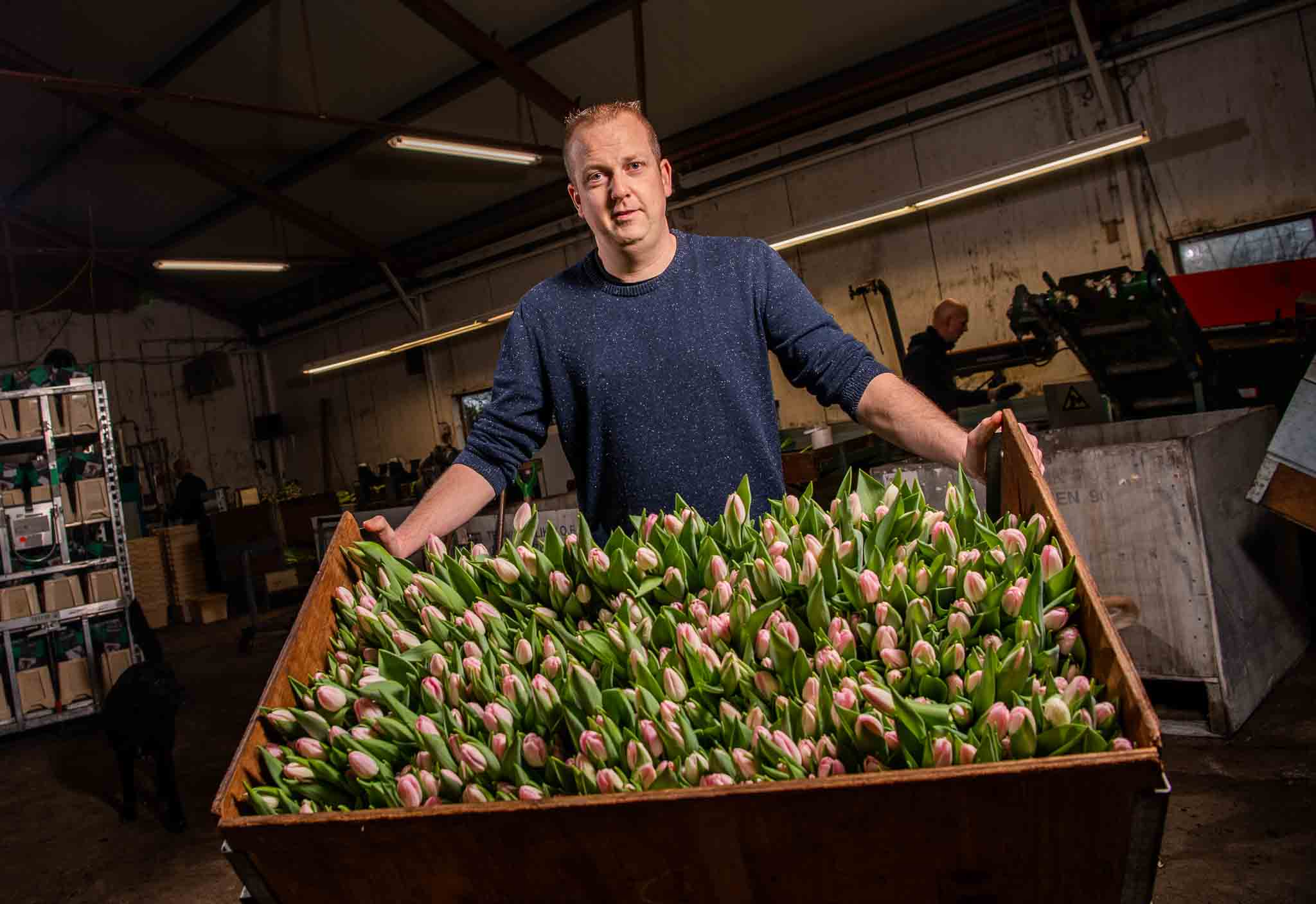
Let’s return from ice-covered roads to the flower-covered fields of the Netherlands. In addition to the natural conditions that promote flower growth, there are also many techniques employed by humans that do so. We were fortunate to meet a local grower of tulips and chrysanthemums, another significant flower crop to the country’s economy, at the Decorum flower company. He described a unique pest control process that avoids overreliance on chemicals and features a surprising contributor: spider mites. While many consider these arachnids to be pests themselves, the grower explained that the proper density of them–around six hundred per square meter–is beneficial, for they consume insects. From using vents to disperse spider mites across the greenhouses to placing white strips containing them between the flowers, Decorum has found innovative ways to control the population size.

Conclusion
Before this trip, when I would purchase a tulip or chrysanthemum, I often admired its beauty but overlooked the complexity of the biological and human-run processes that enabled its growth; fortunately, I have now developed a deeper appreciation of these simple treasures, and I hope you have as well.
Sources
- Thank you to our guide in the Netherlands and a grower at Decorum for sharing the information upon which this post is based.
- https://www.kremp.com/pages/history-of-tulip-mania?srsltid=AfmBOorI38rzQ2QHEBBBPKxOhJxRfkwDEu8NBydyk16y7qQkEYu8QSZp
- https://tulipfestivalamsterdam.com/tulips-grow-well-holland/#:~:text=Best%20climate%20for%20growing%20tulips,up%20for%20our%20free%20newsletter.
- https://amsterdamtulipmuseum.com/blogs/tulip-facts/why-do-tulips-need-a-cold-period
- https://chem.libretexts.org/Bookshelves/Physical_and_Theoretical_Chemistry_Textbook_Maps/Supplemental_Modules_(Physical_and_Theoretical_Chemistry)/Physical_Properties_of_Matter/Solutions_and_Mixtures/Colligative_Properties/Freezing_Point_Depression
- Feature image: https://decorumplantsflowers.com/en/press/