

Introduction
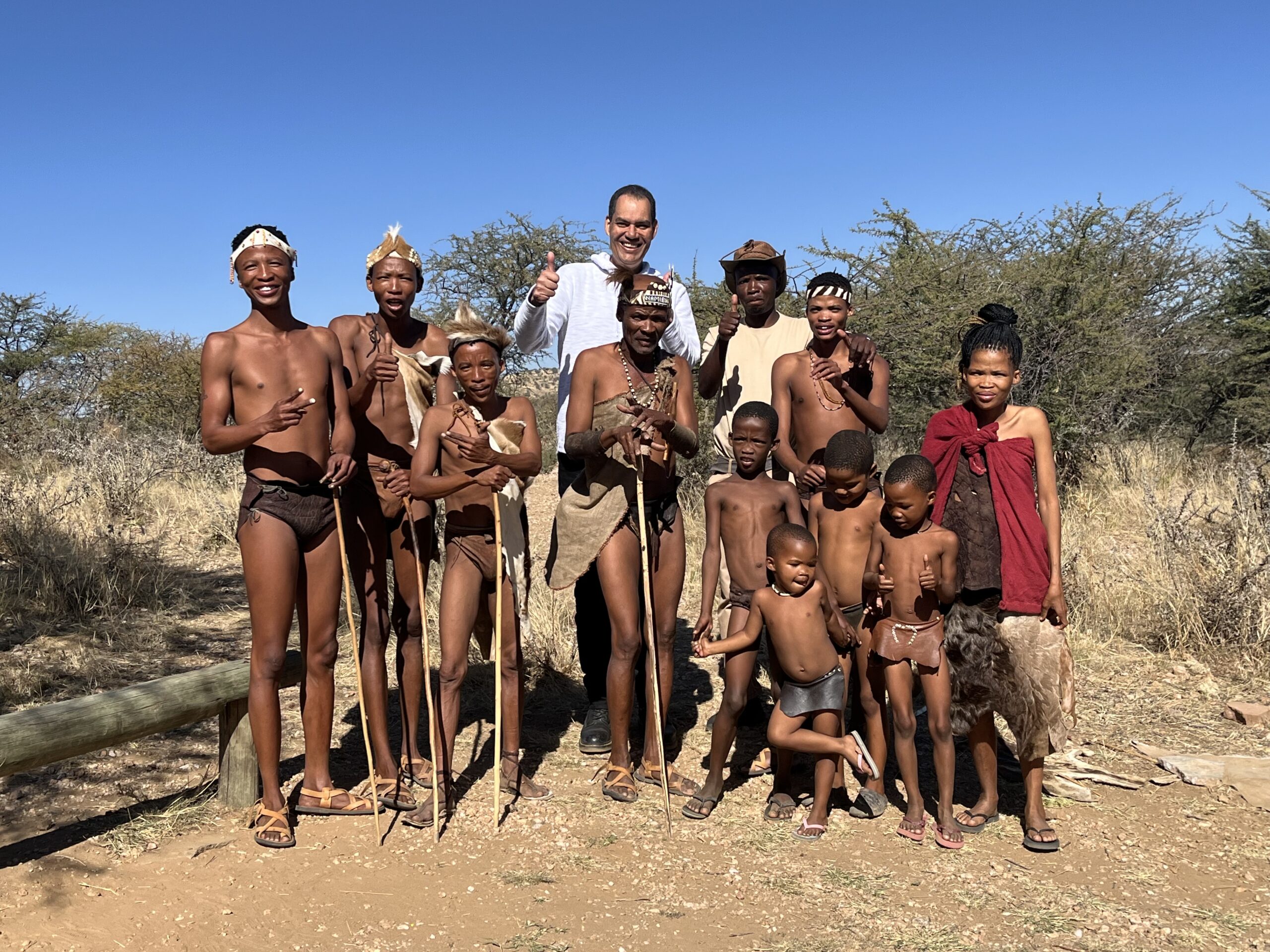
In my last post, I explored the Himba people of Namibia, but I wanted to discuss another ethnic group that has developed a dissimilar lifestyle in the same country: the San. Not to be misconceived as monolithic, the San people consist of multiple unique communities. During our trip, we had the pleasure of taking a tour by members of The Bushmen’s Survival Trust, who are part of the Ju|’hoansi. Although their firsthand accounts were priceless, I hope to capture the information they imparted about their culture and how best to support the trust or similar initiatives.
Background

The San are part of the Khoisan grouping–whose other primary subgroup is the Khoikhoi–of eastern Namibia, western and central Botswana, and neighboring countries of South Africa. The San and Khoikhoi share linguistic and cultural traits, especially their use of click consonants in their languages, which differentiates them from Bantu speakers. Another unique feature of these click languages is the numerous specialized terms for the inside of the elbow or back of the knee, for instance. Despite such parallels and their history of cohabitation, the San and Khoikhoi are distinct ethnic groups.
The former are recognized as the first-known inhabitants of southern Africa, for archaeological and genetic evidence indicates that they have resided here for at least twenty-thousand years. Historically, the San were primarily seminomadic hunter-gatherers–given that the desert is too dry to afford crop growth and livestock farming–while the Khoikhoi arose from a San group that embraced a pastoralist lifestyle. Over hundreds of years, the San retreated or assimilated into others, such as the Bantu, who had relocated to their lands from the north by the third century BCE. Consequently, the communities were forced into the hostile, semiarid parts of the Kalahari Desert, and there are few remaining descendants.

bantu-migrations/

The San, located at the time just beyond the borders of the Cape of Good Hope, faced further challenges when Dutch settlers, or the Boers, arrived in 1652 and founded Cape Town, which initially served as a supply station for ships to Asia but later became a permanent settlement. The Boers perceived the San as menacing and irrevocably barbarian; in fact, upon their encounter, they deemed the San wild “Bosjesmen,” or “Bushmen,” a term that is now considered outdated or even derogatory. (Although it is not solely an exonym–for it was used by our guides, including the tribespeople themselves–some consider “San” a superior description of the group’s lifestyle because it allegedly originates from its word “sa,” which signifies “gatherers of fruit” or “harvest.”) The negative stereotypes imposed on the San were only reinforced by their raids to seize the settlers’ cattle, and consequently, the Boers executed a prolonged extermination campaign.
Ultimately, the sporadic Dutch-San Wars, from 1676 to 1861, destroyed the majority of the San population. Records for merely 1785 to 1795 indicate that 2,500 San were murdered while an additional seven hundred were captured and enslaved. Surviving tribespeople endured persisting oppression and even enslavement by Black and white farmers alike. The San, having been deprived of their lands and hunting traditions, were left with only the Kalahari Desert as their refuge despite its unfavorable conditions. Even today, the San are disempowered, particularly in Botswana, where the government deems them “Stone Age creatures,” they have been continually stripped of territories, and they have been prohibited from executing their hunting practices. Just twenty-three years ago, they experienced land dispossession as part of Botswana’s attempt at ethnic cleansing, to which the government has drawn the dehumanizing analogy of the culling of elephants.
The San in the Past
Procuring Food
Evidently, the San have been subject to lasting prejudices against their traditional culture; however, they have long showcased advanced practices. For instance, they established fruitful techniques for pursuing animals such as eland, kudu, impala, and bushbuck with nets and traps as well as with spears and arrows covered with a poison. All parts of killed animals were consumed, and their skin was used for clothing and bags.
How did the San’s equally sophisticated toolmaking enable them to prepare game? Well, the Wilton Stone Kit, a series of tools from around fifteen thousand years ago that was attributed to the San, was recovered in Cape Province, South Africa. The collection indicates an advanced capacity to make tools such as scrapers, borers, and microliths, likely employed to butcher animals.
How frequently hunting provided meat is undetermined, but women and children, most of the gatherers, supplied almost 80% of the San diet. Probable daily foods include honey, fruit, mongongo nuts, insects like grasshoppers, and smaller animals like tortoises and mole-rats. Women likely acquired wild roots and plants from the over one hundred varieties in the area as well, as indicated by discovered digging sticks and grinding stones. San who resided near the coast also caught fish, rock lobsters, seals, and mussels in reed baskets. Overall, hunters and gatherers collaborated to provide for their family groups or bands, which consisted of anywhere from ten to sixty individuals but frequently shifted in size due to polygyny, relocation, and deaths.

Art

Due to their coordinated means of nourishment acquisition and the time limits they applied to them, the San could spend considerable time developing their cultural practices. Therefore, their cave paintings and decorative jewelry, created from ostrich eggs, are amongst the most widespread forms of prehistoric art in southern Africa. The former, portraying scenes of hunting, dancing, and spiritual rituals, serve as snapshots of the San people’s beliefs and lifestyle. For instance, in some, the Ju|’hoansi can be seen partaking in healing dances intended to protect against hardship, such as sicknesses, that was believed to be caused by spirits. San artistry extended to the production of numerous musical instruments, perhaps for social or ritual practices.
The San Today
As the aforementioned perceptions of the San as primitive arose, how did they affect the preservation of a culture that, as even its early practices illuminate, is far from it? Around twelve thousand years ago, humans began to transition from a nomadic hunter-gatherer lifestyle to settled agriculture, a shift that marked the start of the Neolithic revolution. However, due to Namibia’s isolated regions and low population density, the San maintained the former subsistence mode for tens of thousands of years. Nevertheless, as mentioned, the communities have long been uprooted from their ancestral lands as a consequence of agricultural expansion, industrial development, conservation projects, and governmental policies. Such disruption to their traditional lifestyles jeopardizes the extensive cultural legacy and knowledge on to which they have held for millennia. Some San have adopted agriculture, livestock herding, and wage labor in addition to or in replacement of their traditional practices. The trust members, proficient in bushcraft, are the final generation connected with elders who lived completely immersed in nature. Therefore, while the following characteristics of their current lifestyle bear resemblance to the past practices we discussed, they are not applicable to those of the entire ethnic group, which, both with regard to responses to modernization and in general, is by no means homogenous.

Utilization of Plants and Animals
The Ju|’hoansi remain well versed in desert biota and have thereby used natural resources to their advantage as opposed to succumbing to the challenges of their arid environment. Aardvarks consume termites by utilizing their strong claws to rip open the mounds before slurping up the exposed termites with long, sticky tongues, coated in saliva. Subsequently, they rest due to stomach discomfort and thus enable the Ju|’hoansi to track and hunt them more easily. After doing so, the tribespeople apply aardvark fat to their skin to insulate themselves against the cold and repel mosquitos. Another nature-based trick is storing water in ostrich eggs, which are so capacious that they can fit thirty medium-sized eggs and so durable that they can bear up to 120 kilograms.


Many Ju|’hoan practices serve purposes beyond mere practicality by enriching the culture, as exemplified by the continued aesthetic use of ostrich eggs, along with seeds: creating bracelets and necklaces by adeptly forming miniscule discs that are subsequently strung together. Another aspect of San culture that the Ju|’hoansi have sustained is cocoon rattles. African wild silk moths spin strong cocoons that function as protective shells shielding the pupas from predators, parasites, and harsh environmental conditions until they have completed their transformation into adult moths and emerge from their cocoons. Such cocoons, often found on camelthorn trees, serve as unorthodox musical instruments for the Ju|’hoansi, who cut them open, consume the caterpillars within, fill the empty shells with stones or seeds, string them together, and place the result around their ankles to create rhythms during their dances.


Regarding their enduring reliance on traditional plant resources, the Ju|’hoansi use Acacia mellifera, also known as the blackthorn acacia, for firewood; the gum of injured stems as a source of vitamins; and the bark as medicine to alleviate flu symptoms. They also trap the kori bustard, the largest flying bird native to Africa, by arranging sticks right below the blackthorn acacia, of whose gums the animal is fond. The Ju|’hoansi’s hunting practices involve additional natural materials, such as the branches of Grewia flava (the brandy bush) that comprise their bows and arrows. Similar to the acacia in its nutritional and medicinal value, Boscia albitrunca, or the shepherd tree, possesses sweet orange or yellowish berries that the Ju|’hoansi collect, and they also boil its leaves to make a treatment for stomach issues. When experiencing fevers or congested noses instead, they inhale the leaves of the Kalahari fever bush, known amongst the Ju|’hoansi as the medicinal tree. Furthermore, the manketti, or mongongo, nut is highly nutritious as an important source of omega-6 fatty acids and vitamin E in the Ju|’hoansi’s diet. Wild cucumbers supply not only nourishment but also hydration in arid regions; the Ju|’hoansi squeeze the water out of such plants as they do with certain roots and melons. To maximize their ability to acquire and save water, they also use straws to suck it up through the sand, and when a woodpecker drills a hole into a camelthorn tree’s trunk, it unintentionally forms a reservoir that the Ju|’hoansi can subsequently use for water storage, a serendipitous symbiotic relationship.
Fire Making
While all the aforementioned practices are critical to the Ju|’hoansi’s flourishing physically and culturally, amongst the most indispensable skills in the African wilderness is firemaking, for which they continue to employ the ancient method of producing friction. Ju|’hoan hunters carry firesticks–usually from the mopane tree, brandy bush, and Kalahari raisin–in their quivers. The sticks, which must be parched, are ideally from wood of mid-hardness and with large, soft inner cores. One firestick, the “driver” stick, must have a sharp point, which can be achieved by rubbing it against a rock or stone. The second, the “kindle” stick, possesses off-center indentations in which the “driver” stick can be inserted. The Ju|’hoansi rapidly rotate the former to create friction, which generates sparks and eventually ignites a bundle of dry grass or other tinder. When this material begins to smoulder, a Ju|’hoan person blows on it to start the flame before feeding it with twigs to create a larger fire.

Hunting
Hunting likewise remains at the basis of the Ju|’hoansi’s lifestyle. The tribespeople prefer to hunt in the daytime heat, for many prey animals overheat more easily when fleeing than humans do when pursuing them, especially during the hottest times of the day. Therefore, the former eventually fall from fatigue and enable the Ju|’hoan hunters to kill them, primarily using bows and arrows, which require the shooters to get quite close and thus the game to have collapsed. Although generally formed from stone and bone, some arrowheads are now made of metal pieces. When asked, one Ju|’hoan guide admitted to preferring the contemporary method due to metal’s superior strength, durability, and capacity to remain sharp, an indication that modern advancements can facilitate rather than destroy traditional practices. Regarding the bows, the Ju|’hoansi have maintained the use of fibers from plants, such as the makalani palm–the same material crafted into the rope used to trap animals. After fibrous leaves are harvested, they are continually pounded to separate the fibers from the pulp. Subsequently, the extracted fibers are twisted into durable cords, and the juice produced by the plant may be squeezed into ears to cure infections.

Since the Ju|’hoansi’s arrows alone would be inadequate in subduing large prey, they still apply poison to them as in the past, but the specific substances employed vary. While some San groups use mixtures derived from plants, including the aforementioned blackthorn acacia, or from poisonous snakes, Namibian Ju|’hoansi typically use the larvae of Diamphidia, which contain the noxious compound diamphotoxin. According to our guide, these beetles lay their eggs on the stems of shrubs from the Commiphora genus. Subsequently, the mothers coat the eggs with their feces, which harden into protective layers. Once the eggs hatch, the larvae develop through instar stages, during which they shed their fecal coverings and burrow into the ground. Here, they form cocoons and enter a dormant pupal stage before becoming adult beetles. During this period, which can last numerous years, Ju|’hoan hunters dig at the base of the plant to obtain the dormant larvae. They then squeeze the toxic hemolymph, a fluid similar to blood, of up to ten onto an arrow, specifically the foreshaft as opposed to the point itself to avoid being poisoned if scratched by the latter. Afterward, they may dry the arrow over a fire. Alternatively, the larvae are mixed with plant juices, which functions as an adhesive, and saliva before application. A third method involves drying the larvae in the sun, grinding them into a powder, and combining the result with plant juices. Regardless, the preparer should not possess any open wounds to avoid fatal poison absorption.

If they shoot prey when it is upright as opposed to after it has collapsed from exhaustion, the Ju|’hoansi follow its tracks or scent until it is subdued, a process that can span a few hours or a few days depending on the animal’s size. While the arrowhead remains lodged in the kill, the shaft is detachable, so even if the wounded prey shakes this part loose, it does not dislodge the entire arrow, with the portion to which the actual poison is applied. The poison affects mainly the area around the wound rather than permeating the animal’s body because its circulatory system stops functioning upon death. Therefore, the Ju|’hoansi can still safely consume the meat after cutting away the tissue around the wound and applying heat, which inactivates the toxin, during the cooking process. They take additional precautions by immediately draining the prey’s blood to remove some of the poison that may be in its bloodstream.
Living Accomodations

Although the Ju|’hoansi’s subsistence strategy demonstrates their collaborative abilities and environmental expertise, how do their man-made structures reiterate their connections with each other as well as nature? Traditionally and today, they reside in huts organized in a circle to encourage social cohesion by promoting communal activities like storytelling. Since the homes feature available natural resources such as branches and thatch and thus have minimal impact on the ecosystem, they illustrate the Ju|’hoansi’s compatibility with their environment. Moreover, the readily accessible building materials make the huts easily assembled and disassembled to accommodate the Ju|’hoansi’s highly mobile lifestyles.
Conclusion
Although we humans were hunter-gatherers for at least 90% of our history, the San, just as the Himba people, have experienced significant marginalization due to their maintenance of this lifestyle, and consequently, increasingly more tribespeople have deviated from their ancestral ways. Consider supporting The Bushmen’s Survival Trust to strengthen one of the modern world’s few remaining links to traditional San culture; furthermore, aim to bolster the programs that other organizations, such as the Tribal Trust Foundation and the Kalahari Peoples Fund, have dedicated to the ethnic group. The San Youth Network is a fitting option if you want to enable San youth to reconnect with and thereby sustain their culture. If you have the opportunity to visit Namibia, I would again encourage you to partake in a tour with The Bushmen’s Survival Trust, and please buy from the on-sight art gallery that displays the Ju|’hoansi’s expertly crafted works.
Sources
- Thank you to our guides in Namibia for sharing the information upon which this post is based.
- https://online.infobase.com/Article/Details/419204?q=San%20people%20Namibia
- https://online.infobase.com/Article/Details/256630?q=San%20people%20Namibia
- https://online.infobase.com/Article/Details/258075?q=San%20people%20Namibia
- https://online.infobase.com/Auth/Index?aid=15481&itemid=WEHRC&articleId=214688
- https://online.infobase.com/Article/Details/159251?q=Bushmen
- https://www.gateway-africa.com/howdidthey/traditional-fire-making.html
- https://www.biodiversityexplorer.info/beetles/chrysomelidae/alticinae/arrows.htm#:~:text=Some%20use%20plant%2Dderived%20substances,beetles%20in%20the%20genus%20Diamphidia.