

Introduction
Previously, I delved into the Himba and San people and discussed ways in which both ethnic groups have adapted to their arid surroundings. As my explorations illuminated, humans depend less on somatic, or bodily, adaptations to endure environmental conditions than on their cultures, their extrasomatic means of adaptation and survival. Today, however, I will peer through a biological lens, which Riya usually utilizes, to explore the somatic adaptations of the plants and nonhuman animals we encountered in Namibia. In the process, I aim to crystalize my, and hopefully your, understanding of the distinctions between their primary survival methods and those of us humans.
The Namib: a Paradigm of Adaptations to Aridity
The Namib desert displays the morphological, physiological, and behavioral adaptations that enable plants and animals to survive, grow, and reproduce while experiencing extreme aridity and temperatures. Specifically, they face the following main challenges to reproduction and survival: water, heat, food, and competition.
Water
What are the dangers of water loss, and how does it occur? In The living deserts of Southern Africa, emeritus professor Barry Lovegrove refers to water as the “currency of life” in desert environments. Yet, body fluid regulation is crucial for organisms in any environment to prevent lethal biochemical imbalances. Specifically, if mammals lose over 10% of their body water, they suffer from increased concentration of bodily fluids, and if plants do not carefully manage their water content, gas exchange during photosynthesis is impeded. At the surfaces of both plants and animals, water loss occurs via evaporation. In the latter, it also results from breathing and in the former, from transpiration, when water passes through mainly stomata–or the openings through which they exchange gases with their environments–on their leaves. External temperature and water vapor pressure dictate the rate at which water is released.

How do organisms’ shapes also affect the rate of water loss? Due to their higher surface-area-to-volume ratios, smaller organisms experience water loss faster. For instance, a 0.1 kilogram desert gerbil evaporates 13% of its body weight per hour while a 500 kilogram camel does so seventeen times more slowly. Therefore, numerous Namib plants, including species of Adenia, Commiphora, Cyphostemma, Euphorbia, and Hoodia, exhibit a short and stout growth form, also known as a caudiciform or pachycaul life form, that minimizes their surface-area-to-volume ratios.
What are some other ways in which plants prevent water loss? Taking a different approach to water conservation, several desert succulents follow Crassulacean Acid Metabolism (CAM), a photosynthetic pathway. Such plants open their stomata during the night, when humidity is higher and temperatures are lower, to permit carbon dioxide to enter their leaves; however, they keep them closed during the day to prevent water from escaping. Overall, they reduce water loss but still perform photosynthesis to produce essential energy.

Certain desert trees, like Commiphora anacardiifolia and Cyphostemma currorii, can go without rain for extended periods due to another trait that assists photosynthetic activity: large, fleshy, and deciduous leaves, which, after rainfall, enable the trees to absorb and store water as well as carbohydrates quickly. How do these qualities afford such critical functions? Well, big leaves maximize the absorption of sunlight and thus accelerate photosynthesis; fleshy ones serve as water storage organs; and deciduous ones fall during dry periods to conserve water and energy that would have been lost via transpiration, for example, but they are rapidly regenerated during active growing periods, when they can capitalize on moisture. Besides such leaves, desert plants commonly store water in bulbs, tubers, or trunks.
What are some ways in which plants, as well as composite organisms, capture water, and how do animals capitalize on their moisture contents? In addition to reducing the loss of water, desert organisms must optimize their means of capturing it. Within the fog belt, the psammophyte Stipagrostis sabulicola, for instance, catches fog droplets on its long leaves, and they proceed to its base and into the root zone, where they are absorbed by the plant’s extensive root system. Similar behavior is evident in lichens, which are made up of an alga or cyanobacterium partner (the photobiont) and a fungus partner (the mycobiont) in a mutualistic relationship. During the majority of the day, lichens are inactive, but at night, they derive moisture from the fog. Upon being hydrated, they initially utilize stored energy reserves to metabolize, but during sunrise, the photobionts photosynthesize using solar radiation before the composite organisms quickly become dehydrated again.


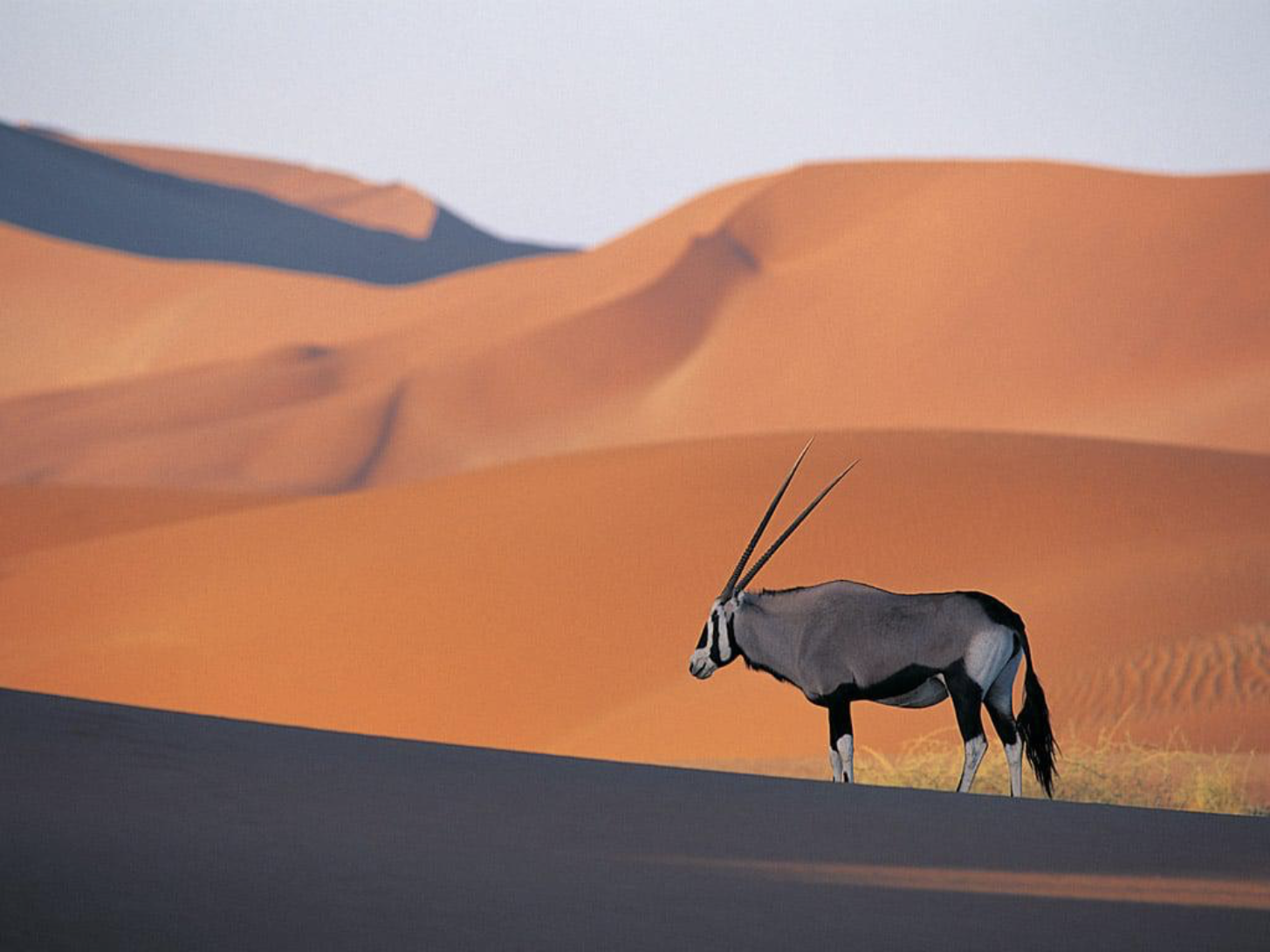
When their moisture is at its highest, animals suck it from lichens and similar creatures, as demonstrated by the gemsbok in Iona National Park, which graze on the grass Stipagrostis uniplumis at night. During this time, its moisture content is 26% as opposed to merely 9% as it is at midday. Likewise, the brown hyena consumes Citrullus lanatus (watermelon) and Acanthosicyos naundianus (Gemsbok cucumber), potentially more due to their water content of up to 90% than due to their nutrient content. Numerous desert animals look to another melon, Acanthosicyos horrida, for food and water. In fact, as we explored Etosha National Park, we spotted an oryx eating one by taking a small bite before hitting the raw fruit with its horns to enable further consumption.
As with lichens, Acanthosicyos horrida melons not only contribute to the adaptations of animals that interact with them but also exhibit their own. Specifically, they reduce their leaves to sharp spines–which, by decreasing surface area, minimize sun exposure and water loss–but compensate for their lack of leaves via photosynthetic stems, thorns, and flowers.
What are some ways in which animals prevent water loss? Beyond using plants and composite organisms to hydrate, animals exhibit numerous water conserving adaptations. For instance, insects have waterproof cuticles, reptiles have scales that serve as barriers against water loss, and mammals have fur partially to maintain moisture within their bodies. At roughly one tenth the water loss rates of mammals, those of desert reptiles are the lowest. Nevertheless, small mammals, including the Namib golden mole, display the behavioral adaptation of burrowing under the sand and entering torpor, in which their body temperatures are reduced, to regulate these temperatures as well as their moisture levels. For the same purposes, bigger mammals, including springbok, utilize the shade of trees.


The species Burchell’s sandgrouse also showcases fascinating behavioral adaptations. The male adult flies up to sixty kilometers to the most proximate water supply, where the birds tend to nest; submerges his highly absorbent anterior feathers; gathers water; and transports it back to the nest. He holds his water-absorbent feathers close to his belly to avert water loss via evaporation as he flies home, where young chicks grasp the feathers, still wet, with their beaks and remove the water from them.

Since water loss commonly occurs when animals are creating waste products, numerous desert mammals, such as short-tailed gerbils and Kirk’s dik-dik–the smallest antelope in southern Africa–possess kidneys that concentrate urine to minimize the water that the process requires.
How do organisms prevent water loss during gas exchange? Despite our previous discussion of waste production, both animals, via respiration, and plants, via photosynthesis, lose the most water during gas exchange. To minimize such water loss, grasses and succulents, as alluded to, use CAM and C4 metabolic pathways, which lead to carbon fixation, whereby inorganic carbon is converted into organic compounds, and which provide plant species in hot, dry areas with an evolutionary advantage.

With regard to animals, insects’ spiracles are their equivalent to plants’ stomata. Such analogues illustrate convergent evolution, the process by which species with distinct ancestry independently develop alike traits to adapt to alike environmental challenges. For instance, the tenebrionid beetles of the genus Onymacris exhibit fused elytra, the hardened forewings that spread when other beetles are in flight and which cover the abdominal spiracles. Although these fused elytra render the beetles flightless, they aid water conservation by sustaining a high humidity and restricting gas exchange to only one opening, which is near the anus and usually closed unless briefly opened to provide ventilation.
What are some other ways in which some tenebrionid species prevent water loss? During sunrise, the beetles come out from under the sand and assume a headstanding stance. Incoming fog accumulates on the fused elytra before rolling down to be consumed orally and thereby raise the beetles’ body water by up to 34%. This behavioral adaptation enables Onymacris unguicularis and Onymacris bicolor to survive long rainless periods while populations of other tenebrionid species, without this water source, are destroyed during them. The nocturnal Lepidochora discoidalis, another tenebrionid beetle, creates shallow trenches in the sand of sea-facing dunes that serve as an accessible drinking water supply by trapping fog moisture.

Heat
Why does the Namib desert necessitate temperature regulation? Desert climates often experience rapid heating during the day and significant cooling at night mainly due to the low humidity and clear skies. The surface temperature of Namib desert sands can reach 75°C during a summer day but drop to below 0°C during a winter night. Organisms, which generally operate optimally within narrow temperature ranges, must develop thermoregulatory methods in the face of such significant seasonal and daily fluctuations.
What is the distinction between ectothermy and endothermy? Thermoregulation in animals falls into two main categories: ectothermy and endothermy. Ectotherms–which include insects, reptiles, and amphibians–can bear fairly dramatic temperature shifts and thus sacrifice the capacity to function optimally at all times. They obtain their heat from external sources, and the majority utilize the sun to heat themselves to their ideal operational temperatures and manage energy expenditure. In contrast to flying birds and active mammals, ectotherms cannot move about freely, for they may grow either too hot or too cold. When their surroundings deviate from their optimum body temperatures, ectotherms conform.
On the other hand, endotherms can sustain relatively consistent body temperatures at all times by producing heat within their bodies, so they can function optimally whenever and wherever they wish. They include mammals, who regulate their temperatures between 34 and 38°C, and birds, who do so between 39 and 42°C. When environmental temperatures are low, endotherms, seeking to generate more heat, burn energy until peak metabolic rates are achieved, but if their surroundings continue decreasing in temperature, they may experience hypothermia, which could be lethal. In the face of hot conditions, endotherms cool down via evaporation, which occurs when mammals sweat or pant and when birds perform gular fluttering by opening their mouths and rapidly vibrating their throat muscles. This process has a cooling effect because the large amount of energy required to break the hydrogen bonds between water molecules is absorbed from the surrounding environment, so the evaporating surface decreases in temperature. However, if mammals’ body temperatures reach 42°C or those of birds 45°C, they enter hyperthermia and die. Despite these limitations, mammals and birds can select the places they inhabit and be highly mobile because they do not have to conform to their external environments’ divergences from their optimal body temperatures. Now that you understand that endotherms can thermoregulate effectively, you may be wondering, . . .
What are some specific physiological adaptations they exhibit to do so without experiencing water loss? This question is a valid one considering that evaporation is water intensive. Well, gemsbok and various other desert antelope have developed extraordinary vascular anatomies and response physiologies to help them survive the dehydrating summer heat. Thanks to a physiological response known as selective brain cooling, they can permit their body temperatures to rise to as high as 43°C. Although blood at this temperature fed directly to the brain would be lethal, the animals’ brain temperatures stay within functional limits via the carotid rete system, a network of venous and arterial blood vessels. Specifically, when a gemsbok feels hot or dehydrated, it begins to sweat and pant. Due to these evaporative cooling processes, the temperature of the venous blood in its nasal sinuses decreases. Hot, oxygen-rich arterial blood from the lungs passes through the carotid rete and is cooled by the transference of heat to the cooler venous blood. Therefore, the blood passing through the carotid artery and destined for the brain drops to 40°C, which, in contrast to 43°C, is a safe temperature. When the hypothalamus, the brain region that regulates body temperature, receives this cooler blood, it declines in temperature and thus no longer triggers heat loss mechanisms, such as sweating and panting. Since these actions also cause water loss, gemsbok can conserve water on extremely hot days, a fact that explains why they and various other ungulates thrive in Iona National Park despite the lack of open water sources.

Why do some endotherms impermanently revert to heterothermy as an additional physiological adaptation? Certain animals, particularly those frequently subject to cold nights and winter temperatures, can temporarily switch from possessing the thermoregulatory abilities of an endotherm to possessing those of a heterotherm–an intermediate state–via torpor or hibernation. The associated advantage of doing so is lowering the energy expenditure required to maintain a constant body temperature. For example, in Angola, when white-backed mousebirds from the Kunene valley enter torpor at night, their body temperatures shift from 40 to 26°C as their metabolic rates decrease to conserve energy.
What are some ways in which endotherms employ behavioral adaptations to bolster their energy conservation efforts? Amongst the numerous behavioral adaptations that facilitate thermoregulation is one employed by the majority of small desert mammals, like gerbs: they seek shelter from the midday heat of summer or cold of winter nights in burrows. Similarly, ground squirrels’ bushy tails serve as umbrellas that shade them as they forage and feed; springbok and steenbok search for shady trees; and gemsbok climb to the peaks of dunes to enjoy the cool breezes. Moreover, many mammals like springbok graze sunward to minimize sun exposure and thus heat absorption while concurrently concealing themselves from predators.
How do plants respond to changes in body temperature? Plants can withstand changes in body temperature better than animals, for the aforementioned adaptations that enable water efficiency also decrease heat stress. In fact, certain succulents can survive temperatures spanning 16 to 68°C.
How does the boundary layer influence adaptations to heat? The boundary layer above the soil or around a leaf–a thin region of still air that affects the pace at which gas or energy is exchanged between the soil or leaf surface and surrounding environment–is another physical factor that significantly influences adaptations to heat. The temperature gradient, or rate of temperature change, in the first few millimeters above a sand or rock surface is very steep, and there is a similarly rapid decrease in temperature as the depth below the sand surface increases. Certain desert insects and reptiles take advantage of this fact. For instance, the beetle Stenocara phalangium has unusually long legs that enable it to walk as if on stilts; they lift the beetle’s body above the temperature boundary layer of their environment’s desert gravel surface. Likewise, the shovel-snouted lizard has behaviorally adapted to hot sand. It performs a dance that involves alternately lifting its front and back legs, as well as utilizing its tail as a lever, to elevate its body above the hottest levels of the boundary layer. Also to evade the surface heat, it can dig below the sand to cooler levels.


Competition for Food
What are some ways in which resource scarcity is prevented? When at least two individuals utilize the same resource but it is scarce, competition occurs. In the desert, rainfall events are rare, unpredictable, and distinct periods separated by dry spells while heat is dehydrating. Consequently, primary production–the process whereby autotrophs, which produce their own food and are at the base of the trophic pyramid, convert inorganic compounds into organic material–is low, and food security is challenging. In the Namib and Kalahari, three hyena species–brown, spotted, and aardwolf–coexist, but each has a specialized diet to avoid direct competition with the others for food. Habitat partitioning, a process by which ecologically similar species divide resources and occupy different micro-habitats, is also seen in the Namib. Four species of Onymacris beetles use wind-blown detritus and dead insects as shared food resources but have distinct habitats in dune bases, slip faces, floodplains, and riverbeds, all within a restricted geographical area. When resources are limited, habitat partitioning becomes a more pronounced strategy for Onymacris species to coexist, but after abundant rainfall, when resources are copious and interspecific competition declines, it breaks down. Across all settings experiencing resource scarcity, food storage is another widely employed strategy. For example, in the Namib, termites and ants forage for food and build stores during periods of abundance to prepare for lean times.
Rather than engaging in competition to obtain and store food, some, such as Damaraland mole-rats, display cooperative social behaviors to endure harsh environments. Damaraland mole-rats gather massive stores of bulbs and corms, which minimize the need for constant foraging. Moreover, lactating females who have given birth to and are bringing up pups would quickly starve if they were not supported by worker females. This collaborative practice is especially important when sand is dry, for burrowing through it as opposed to damp sand is three times less energy efficient. Overall, in a desert, cooperation enables a division of labor into locating, transferring, storing, and protecting food resources.
Defense Mechanisms
What are some ways in which organisms avoid predation? Since the aforementioned adaptations are otiose if organisms cannot evade predation before transferring their genes to offspring, they have developed means of reducing this risk: avoidance strategies like camouflage, deceit, and mimicry; structures like spines, thorns, and horns; chemical defenses like poisons; etc. Given that plants cannot flee from herbivores, of course, but herbivory hinders their water uptake, they have commonly evolved chemical defenses using secondary compounds–including alkaloids, rotenoids, glycosides, tannins, and phenols–most of which are toxic and some of which are lethal.
In contrast to the majority of mammals, insects can tolerate secondary compounds well. Certain ones, like the larvae of the plain tiger butterfly (Danaus chrysippus) specialize in feeding on milkweeds from the Asclepiadoideae subfamily, which contain the toxic compounds cardiac glycosides. The larvae sequester these milkweeds within their bodies, and, consequently, caterpillars and adult butterflies become unpalatable to predators. As a result, this butterfly species is amongst the most prevalent in southern Africa. It has been so successful that the non-poisonous female Danaid eggfly (Hypolimnas misippus) has developed a nearly indistinguishable appearance and thus convinced predators that it, too, is unpalatable without having to invest in secondary compounds. This form of mimicry, Batesian mimicry–whereby a harmless mimic evolves to resemble a harmful or unpalatable model to ward off predators–is common in numerous insects. Another form, Mullerian mimicry, involves at least two harmful or unpalatable species copying each other’s coloration and warning signals to distribute predation risk. Animals utilize color via aposematism as well by alerting predators that they are poisonous through bold colors. Prey’s appearances can signify more than merely toxicity; pearl-spotted owls deceive predators into thinking they are being watched via markings on the back of their heads that resemble eyes.

Alternatively, predation-avoidance can allow prey to be inconspicuous via camouflage and cryptic coloration, often employed by insects and numerous vertebrate species. Within a species, coloration may vary to be better suited for different habitats. For instance, leopards in arid regions like Iona National Park are paler than those in Bicuar National Park. Even predators may utilize these tactics to promote their own survival; in the Namib, Bitis peringueyi, also known as the Peringuey’s adder, demonstrates both camouflage and deceit by lying in the sand, barely noticeable, but wiggling the tip of its tail to lure prey close enough for it to strike.


Reproduction and Survival
What are some ways in which organisms have come to time reproduction strategically to promote its success? Successful reproduction is essential to the continuation of a species but involves significant risks and energy expenditure; moreover, as has become evident, deserts pose the unique physical challenges of heat, aridity, and unpredictable rainfall. Timing, or ensuring that offspring are born when resources are most readily available, is critical.
For certain groups of animals, the timing of reproduction is controlled by photoperiod, or the length of the daily light period. Photoperiod is sensed by the eye, which sends signals via the optic nerve to the pineal gland in the brain, before this organ releases melatonin. Melatonin affects the activity and growth of the testes and ova, so, overall, daylength drives the cyclical reproductive activity of seasonal breeders.
Rainfall events and the quality of food serve as secondary zeitgebers, or external cues that help synchronize organisms’ internal biological clocks with their surroundings. Rainfall at any point in the year can induce breeding in the sociable weaver birds (Philetairus socius) of the Kalahari, which can have up to four broods during periods of infrequent, high rainfall. Having long gestation periods and thus needing to anticipate future conditions well in advance, large mammals, in contrast, are less likely to have the capacity to respond to unpredictable rainfall events; rather, they depend on photoperiod, which is more predictable.
In certain habitats, breeding seasons are more limited, so many impala or wildebeest calves, for instance, are born within short periods of time and “flood the market” with potential prey. Since predators are inundated with offspring available for consumption, the likelihood of an individual calf’s survival increases. Other species, including springbok, extend their calving periods over longer durations to guarantee that at least some births will coincide with times of ample sustenance.
Conclusion

of_Namibia.svg
Did you know that, in addition to an African fish eagle (Icthyophaga vocifer), the Namibian coat of arms features two oryx and the Welwitschia mirabilis plant? Do you know why these two organisms were chosen? Both are symbols of Namibians’ admirable tenacity in the face of harsh conditions, an indication of plants and nonhuman animals’ abilities to inspire human resilience. Although we sometimes flaunt our extrasomatic means of adaptation as a sign of how advanced and unique our species is, we have much to learn from the organisms we deem primitive.
Sources
- Thank you to our Abercrombie & Kent guides in Namibia for sharing the information upon which this post is based.
- https://link.springer.com/chapter/10.1007/978-3-031-18923-4_11
- https://www.sciencedirect.com/science/article/abs/pii/S1095643308007113
- Feature image: https://www.southerndestinations.com/namibias-incredible-desert-adapted-animals/