
As Chris stepped into the nursery, the soft hum of the ceiling fan and quiet ticking of the clock should have put him at ease.1 Yet his eyes were drawn immediately, even in the dimness of the room, to what jutted out against its careful calm: the large gallon water jugs2 set beneath each crib. They stood with a stubborn, watchful presence3, as if they had taken up some cryptic duty there. The jugs made no sound, offering no hint of their purpose. They pressed insistently against the air, the ordinary stretched taut to contain something larger than itself.4
Chris’ mother-in-law, Geeta, had asserted that the jugs would soften the air the babies drew in, moistening their breath and easing its passage through their tiny lungs. He squinted at them, trying to puzzle through her logic. At first, he had concluded that she was constructing some kind of primitive humidifier, but if the jugs were tightly sealed, how could their contents possibly alter the air at all?5 If anything, although he loved her dearly, Geeta’s insistence on employing such enigmatic methods had the opposite of her intended effect; the air felt oppressively dense rather than softened. For a brief moment, as he lingered near the cribs, the air gathered around him, close but not suffocating, encircling him like an embrace. Yet the pressure built until it grew constricting, difficult to move within, and he found himself resisting it, straining against what only moments before had seemed to hold him tenderly.
Before he had fully registered the impulse, Chris reached out and gathered the jugs, carrying them to the cabinet and restoring them to their rightful place on the shelf.6 When he returned to the nursery, the ordinary calm had settled evenly over the room, but the air seemed to be . . . missing something, as though it had cleared too quickly, leaving behind a thinness that felt easier to navigate but insufficient, no longer capable of holding him7. In that growing void, a memory began to take shape.
The cramped room in Oxford returned with startling clarity, the memory undiminished by the two decades that had passed since he had last lived there. He avoided making eye contact with his future mother-in-law, intimidated by the weight of her unwavering gaze. Geeta’s questions arrived slowly at first, like light, testing jabs. And then, without warning, they escalated into a relentless barrage, each inquiry probing his vulnerabilities and landing with increasing force. The air thickened around him, heavy with gunpowder, and the walls leaned closer, pressing him into the chair8 as she, too, leaned in for a closer, scrutinizing look.
At first, he felt under siege. His words stumbled out defensively, a fragile barricade against relentless examination, and he drew inward, retreating from the mounting pressure of her questioning. As he continued to speak, however, subtle changes in her demeanor began to emerge: the way she lingered after certain answers, the softening of her eyes as his care for her daughter grew evident in each measured response. Gradually, he realized that the questions were not weapons but gestures of devotion, of a fierce love for the woman he, too, cherished–her daughter, his fiancée. The tension in the air eased, and the interrogation softened into a conversation although the force of her attention never waned.
From the corner of his vision, a single plate, spiced and warm, appeared, followed by another, and then another, accumulating without pause, until the narrow dorm-room table had filled itself. Steaming samosas and syrupy jalebi; flaky parathas layered with ghee; silken, cardamom-scented kheer. Steam curled upward in fragrant spirals and encircled him with insistent force, the pungent, unfamiliar spices pressing into his senses and lingering longer than they should, unwilling to disperse. But this time, although he did not lean in, he did not pull away from the bold aroma and the care folded into it.9 He thought of his own mother, measuring spaghetti with careful precision, pausing to level each scoop and taste until the flavors sang softly to one another, their voices low and even.10 Here was a love that demanded presence, that filled the air rather than dissipating, thickening until it could no longer be ignored.
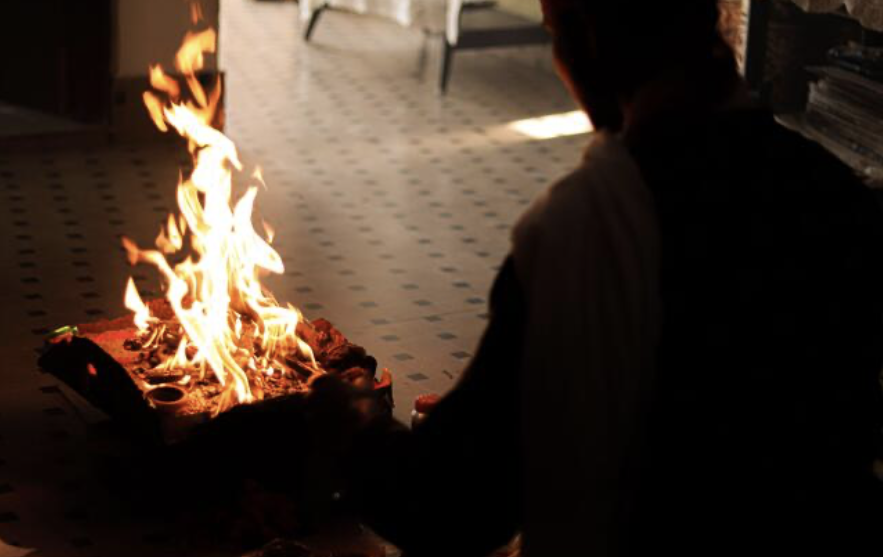
A sudden clatter drew him back to the present. The nursery door burst open, and Geeta stepped in with a portable fire pit for the Griha Pravesh housewarming ceremony. The heat radiating from it, more than the room could contain, pressed immediately against his skin. After Geeta set it in the center of the floor, tiny flames leaped upward in wild, twisting arcs, and incense smoke coiled around the ceiling beams, saturating the air. The fire flared higher, and its shadows slashed across the walls, rising until they loomed large enough to drive back anything that threatened to encroach.11
Chris released a slow exhale edged with exasperation as the room, just settled, swelled once more around him; yet his mind drifted back to those many years before in Oxford, to his realization that Geeta’s relentless probing had been an expression of love. A smile tugged at his lips as he watched her tend to the fire, her features set with firm resolve and illuminated by its fierce glow. He had long tried to resist this insistent, unfamiliar care; now, surrounded by protective flames and enveloped in heat, he leaned into it.12
Geeta noticed his expression and let out a laugh, booming and bright, intensifying the warmth within the room so that it pressed harder against him. “You’ve forgotten something.” Chris’ stomach sank, his cheeks reddening in shame as he recalled his earlier irritation at the jugs’ intrusive presence. He quickly retrieved them from the cabinet and arranged them beneath the cribs. Each hummed with approval upon settling into place, and the space beneath the cribs grew dense once more, the jugs resuming their cryptic duty, now understood.13
Chris remembered the housewarming gift his mother had sent the day before: a candle, neatly boxed, releasing a faint puff of mild vanilla scent that quickly dissipated as he lifted the lid but left a soft smile on his face. Its thin ceramic walls felt smooth and light in his hands. He had set it carefully on the shelf, pleased by the way it occupied its small square of space without pressing beyond it. Now, from across the room, he caught the pale smudge of it on the shelf, the firelight flickering faintly across its surface. For a moment, it seemed almost comical amongst the leaping flames and ponderous water jugs. Yet it did not shrink from the scene, nor was it diminished; it simply held its place, at ease as it and the surrounding presences radiated the unmistakable feel of a mother’s embrace, whether soft in its touch or tight in its hold. He knelt beside the pit and let the heat crawl over his hands, the sharp tang of incense filling his nose. Reaching for a small piece of wood, he fed the fire.14
Margin Notes
This piece served not only as a personal reflection on the evolving relationship between my father and grandmother as they navigated cultural differences but also as an opportunity to put my study of magical realism, part of my broader exploration of Latin American literature, into practice. Notes on my literary choices and use of magical realist techniques are included below.
- Overall, I aimed to show that certain expressions of love can feel intrusive and overwhelming, particularly when viewed through the lens of a culture that tends toward more restrained forms of affection. However, as understanding of these cultural differences develops, that same intensity can be reinterpreted as deeply devoted care. I drew on my father’s real experience with his relationship with my grandmother but exaggerated the discomfort that came with adapting to different cultural expressions of care. Regarding this line, I begin with a realistic setting to ground the story in everyday reality in an attempt to imitate magical realism. ↩︎
- I describe the jugs as visually intrusive because their unsettling presence reflects my message that unfamiliar expressions of care can initially feel uncomfortable. My overarching use of magical realism presents the ordinary as extraordinary to highlight Chris’ initial unfamiliarity with Geeta’s expressions of love and to convey his shifting perception as he gradually comes to understand and accept it. ↩︎
- I attribute intention to inanimate objects to incorporate magical realism. Describing their role as “cryptic” reinforces my message that unfamiliar expressions of love can initially be difficult to understand. ↩︎
- I represent Chris’ emotional discomfort as physical pressure in the air so that his internal feelings take on a tangible, external form. By merging his psychological experience with the physical environment, the story reflects magical realism. ↩︎
- I present Geeta’s reasoning as uncertain because the true purpose of the water jugs is not purely functional but to provide care and protection in a less literal way; their presence embodies her fierce love. By showing this presence having a physical effect on the environment, I incorporate a magical element. Yet, to imitate magical realism, I present Chris’ experience of the air “encircling him like an embrace” not as surprise at the phenomenon itself but as surprise that something initially unsettling could be maternal and comforting. This intention is reflected in the line “such enigmatic methods had the opposite of her intended effect; the air felt oppressively dense rather than softened,” which is not written in an awed tone.
↩︎ - I portray Chris’ restoring the jugs to what he believes is their “rightful place” as an attempt to assert control over and avoid the discomfort caused by what he does not understand, a reinforcement of my message that unfamiliar expressions of love can initially be resisted because they feel intrusive. ↩︎
- My continued personification of the air reflects magical realism and hints at Chris’ shifting perception to suggest that once he moves past his initial unease, he can experience more intense expressions of love as comforting rather than intrusive. ↩︎
- I frame Geeta’s questioning through militaristic imagery, such as a “relentless barrage” that emits “gunpowder,” to depict Chris’ perception of her care as an attack and thereby reiterate my message that unfamiliar expressions of love can feel intrusive and threatening at first. The intensity of the scene reflects magical realism by externalizing his emotions so that they shape the physical environment, a portrayal that emphasizes their effect on Chris rather than presenting his experience as merely subjective. ↩︎
- When describing the abundance of food, which is portrayed as subtly magical, I use the “insistent force” of the steam and the pungency of the spices to convey the intensity of Geeta’s care. Chris’ recognition of the “care folded into” the “bold aroma” and his decision not to “pull away” signal the beginning of his shift in perception; he starts to interpret this initially overwhelming presence as an expression of love rather than an intrusion. ↩︎
- I contrast the restrained, measured expressions of love of Chris’ mother with Geeta’s care to highlight cultural differences in how affection is conveyed (without suggesting that either is superior). ↩︎
- I intensify the physical environment by describing the heat, flames, and smoke as exceeding the room’s capacity so that Chris’ emotional experience of overwhelm is reflected in the space itself. In this way, I continue merging internal feeling with external reality to imitate magical realism. The shadows that “[loom] large enough to drive back anything that threaten[s] to encroach” begin to suggest that this overwhelming force is protective rather than threatening to reinforce my message that Geeta’s fierce love serves as a form of care and safeguarding. ↩︎
- I mark Chris’ shift from resistance to acceptance by contrasting his earlier attempt to “resist this insistent, unfamiliar care” with his present willingness to “[lean] into it,” a more active embrace of Geeta’s expressions of love than simply not “pull[ing] away.” The imagery of “protective flames” and enveloping heat uses magical realism by giving aspects of the physical environment qualities that indicate Chris’ shift in perception, in that they recast what once felt intrusive as sheltering and comforting. ↩︎
- By describing the jugs as “hum[ming] with approval,” I use magical realism to attribute a human-like response to inanimate objects. The phrase “their cryptic duty, now understood” indicates that Chris’ inability to understand Geeta’s expressions of love has shifted into recognition of them as a form of care and protection. ↩︎
- I contrast the candle with the expansive presence of the fire and water jugs to highlight the difference between restrained and bold expressions of love. The candle’s mild scent likewise contrasts with the pungent aromas of Geeta’s cooking to emphasize the difference between cultural forms of care. By showing that the candle does “not shrink” but instead remains “at ease as it and the surrounding presences [radiate] the unmistakable feel of a mother’s embrace, whether soft in its touch or tight in its hold,” I suggest that these expressions of love can all be embraced and that they convey the same underlying care despite their differences. Finally, by having Chris “[feed] the fire,” I end with a symbolic act of participation in the ritual’s protective function to reiterate that he now not only accepts but also seeks to sustain this form of care for his children actively. ↩︎
Sources
- Feature image: https://www.alamy.com/indian-hawan-and-pooja-fire-stock-images-image361942659.html