
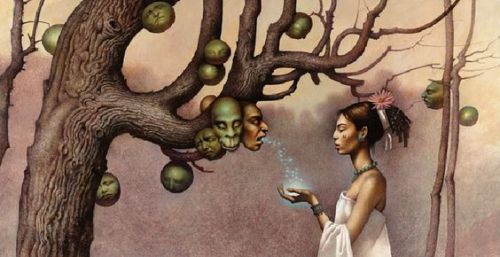
This city is encased in darkness. It teems with unbearable horrors–rivers of scorpions, pus, and blood tear through the land like wounds carved into flesh. From the moment you step through the cave entrance, jagged rocks loom like knives ready to strike, and the air presses down with such oppressive weight that even defiance crumbles into submission. This is Xibalba, a realm of terror–and my home. I am its princess, held captive beneath the looming shadow of my father, Kuchumakik, a Lord of Death. His name alone conjures the sour stench of blood and rotting flesh, the image of eyes sharpened by relentless judgment. Kuchumakik never ceases to remind me that my sole role as a princess is to uphold the family’s honor. How such “honor” could exist in a lineage built on the echoes of anguished screams is beyond my comprehension.
As a princess, I am deemed unfit to partake in killing–only forced to witness the repercussions of disobedience. After the corpses have been laid to waste, I pray for the innocent souls’ safe transport to the afterlife. So when I heard of the calabash tree in Pukbal, on which Jun Junajpu’s decapitated head had been hung, I was eager to pay my respects. Jun Junajpu. That name flared in my memory, and my heart tightened at the recollection. My father told the story of his murder with a grotesque pride that turned my stomach, his lips curling into a radiant smile while mine fell into a grimace of disgusted shock. He and his twin brother had merely been striking the pok-ta-pok ball against the court, but their clamor enraged the lords, who devised devious trials that the brothers were ill-prepared to face.
As I neared the tree, my eyes were drawn to the round green calaveras, unlike any fruit I had ever encountered. Suddenly, one fruit, tucked behind the trunk, popped into view. It resembled a human head, with a defined nose and mouth and two gaping black voids in place of eyes. “Give me your right hand, Princess. My spit will give you my offspring.” I leaped back in shock, both at the realization that the voice was coming from it–or him, rather–and at the absurdity of his assumption that I would allow an anthropomorphic fruit I barely knew to impose such a burden on me! What reason did I have to serve as a mere vessel for his child? As if reading my thoughts, he continued: “I am Jun Junajpu, Princess. Your father may have struck me to death, but a child is like saliva; the parent’s essence resides within it. Through my progeny, I will live perpetually.”
My body tensed with every word, but a calm, reasoned voice rose above the clamoring resentment in my mind: Ixkik’, these children possess an important fate. The descendants of this poor man, for whose death your family is responsible, can carry forward his legacy. This responsibility is too vital to shirk out of selfish indignation. Listening intently to this voice, I knew instinctively that she was right. I extended my palm, still trembling but resolute, and the calavera spat on it. I stared in a daze as the substance shimmered briefly in a thin ray of morning sunlight that had pierced the seemingly impenetrable cave ceiling. I clenched my hand into a tight fist, and with the squeeze of my fingers, a surge of exhilaration coursed through me. No longer would I pray impotently as yet another lineage died–I would help preserve one. “Go back up to Earth. You shall not die. Trust me,” the calavera asserted.
But when the light vanished, a disturbing image emerged from the darkness and shattered my sense of security: the reaction of Kuchumakik, who prized my sexual purity as fiercely as his daily acts of killing, for both served as measures of the family’s honor, and who would inevitably discover my transgression. He always did. My mother had disappeared after bearing another man’s child. My infant ears had caught her wretched screams echoing through the caverns only minutes after she was dragged from our home by her husband, her bloodied footsteps the sole remnants to which I could cling. Until those traces seeped into the cave floor and became locked in layers of hardened sediments–along with the strength and wit the other wives had always told me she exuded. She became yet another of the countless women buried six feet under for sexual impurity, for meeting their husbands’ contemptuous stares with defiant glares, for daring to scream for an end to the brutality. What if Kuchumakik refused to believe that this pregnancy arose not from lust but from the need to continue the lineage of an innocent man? An innocent man whose identity I could never reveal, for my father would never sympathize with a victim of his own cruelty.
I could not conceal my condition for long. My belly swelled, and by the sixth month, I felt my father’s gaze, heavy with disdain, fix upon it. Soon after, he summoned the lords Jun Kane and Ququb’ Kame. Straining to catch their words, I pressed my ear to the jagged wall behind which they stood, shrouded in darkness. My father spoke in a raspy whisper in an attempt to conceal my shameful act. “My daughter is with child,” he said, his tone cold and uninflected. “She has been dishonored.” Even his hushed voice, reverberating through the cave, carried a force that made my limbs tremble.
A suffocating silence followed.
Then came a whisper–whether from Jun Kane or Ququb’ Kame, I could not tell–delivered in the monotone of a seasoned killer. “Force her to speak the truth. If she refuses, sacrifice her. Tear her heart from her chest.” Kuchumakik answered with a low grunt of approval. Suddenly, heavy footsteps began crushing loose stone. He was coming. I scrambled upright and stumbled home. In my haste, however, my foot caught on a jutting boulder, and I fell hard onto my side, pain ripping through my body. Instinctively, my hand flew to my stomach, and when I pulled it away, my palm was slick. Despair surged–until I lifted my hand to my nose. It carried none of the acrid stench of blood I knew too well. Even in the thick of night, a thin blade of light cut through the barrier between Xibalba and the world above. Raising my hand into its path, I saw the liquid gleam a deep red. Tracing its source, I realized a chik’te’ tree towered overhead, its dripping sap a convincing imposter for blood. A laugh of relief and awe tore from my chest–and then clarity struck. This sap, masquerading as blood, could be my salvation. My throbbing feet carried me home.
Minutes later, Kuchumakik seized me by the throat and shook me awake. “Whose child are you carrying?” he roared. My heart hammered, but I clung to the certainty that my plan would come to fruition. “I carry enchanted children, Father, who were conceived immaculately. I have never been with a man,” I answered evenly although a faint stutter betrayed my calm facade. Abruptly releasing my neck, he let me crash to the floor, the thud of my fall muted by his booming accusation: “You lie!” He turned toward a disheveled owl, dark patches of feathers clinging to her skeletal frame, her face hardened by years spent as an accomplice to murder. Although I pitied her evident malnutrition, her remorseless stare reminded me that she had not merely endured suffering–she, eager to serve a masterful killer and clutch death in her talons, had also inflicted it. “Take her to be sacrificed,” he ordered the owl and her three partners. “Bring me back her heart in this bowl.” Without hesitation, the four accepted the vessel and a stone knife. One swept me up in her wings, her exposed bone scraping against my skin.
When we reached the sacrificial fire pit, its stones darkened by the residue of past executions, the owl landed softly and waited for me to descend. I wondered why she had not simply thrown me from her wings and let me plummet to my death, but when I turned to murmur, “Thank you,” I saw fear and concern in her face, not the emotionless expression she had worn before my father. Although uncertain how to read this apparent sympathy, I set my plan in motion. “Please don’t kill me,” I pleaded. “What I carry in my womb is no dishonor. These children were conceived immaculately as I stood before the tree where the severed head of Jun Junajpu became calabash fruit.”
The owls exchanged stunned glances. One, seemingly overtaken by guilt, finally spoke in a trembling voice with downcast eyes. “We witnessed his murder.”
The bird flinched when I gently placed my hand on her wing, but she gradually relaxed beneath my touch as she let tears spill down her face. “I believe the children I carry can uphold his legacy,” I whispered. “Don’t you want to be part of a story of life and preservation rather than death and destruction for once? I understand your loyalty to and respect for your master, but you must recognize that he wields his power for evil.”
The owl finally met my gaze. “Admiration is the last sentiment Kuchumakik inspires in us. Coercion brought us to him, and fear has kept us there. We do not want you to become another body left to decay, and the continuation of Jun Junajpu’s lineage would bring us great joy. But we do not wish to die either, and your father will ensure that we do if he discovers that we spared you.”
“There is no need for fear. Take the sap from the chik’te’ tree, and it will coagulate in the bowl to resemble my heart. You and I still recognize the metallic tang of blood; it burns our nostrils every time another innocent body is reduced to a grotesque emblem of evil’s triumph. But Kuchumakik does not. His nose no longer registers the scent just as his ears are deaf to the cries of suffering. He will not discern the difference. When this ruse succeeds, join me on Earth. I have seen light from the world above penetrate the cave ceiling when the darkness seemed absolute. We, with a strength surpassing the combined blaze of countless rays of light, will break through.”
The owls bowed in gratitude, their tears now streaming in cascades, their callous facades shattered at their feet. “We shall rise to serve you.”
“No,” I asserted. “We will serve no one.”
* * *
The fear I had last felt under the threat of execution surged through my hand as I lifted it to the wooden door. The owls had spotted a crack in the cave ceiling, and we had spent hours breaking away the surrounding rock–first hurling heavy boulders, then prying with our bare hands and claws–driven by a newfound strength that the widening column of light infused into us. With liberty secured, I felt compelled to tell my mother-in-law of the imminent birth of her grandsons, yet only now did I recognize my own naivety. I was fortunate to find allies in the owls, but this is a foreign world, where my scars and bruises, the inevitable marks of life in Xibalba, will invite suspicion. And even if I explain my connection to her family, who would believe that her dead son could, in the form of a fruit, father children? Yet, what kind of person would I be if I denied a grieving mother the knowledge that her son’s lineage could endure? This last thought brought my knuckles to the door.
After a few tentative knocks, I heard the light patter of footsteps. A woman parted the curtains of a nearby window, her expression initially hard with suspicion, then softening with concern. She hurried to the door. “What has happened to you, dears? Have you been hurt?” My lips parted, but words failed me, and my knees grew weak–not just from grueling days of trekking or months of pregnancy but also from a lifetime steeped in death and darkness. The owls enveloped me in their wings, the scrape of bone and sparse feathers inconsequential against the warmth of their embrace. Without hesitation, the woman dropped to the ground and held us with a gentle yet unwavering steadiness that anchored our trembling bodies. Clutching her muscled arms felt like gripping a sturdy branch while navigating treacherous terrain. Once our sobs had subsided into quiet tears, she hoisted us upright with a strength I had not expected of a woman so slight in stature.
After we had thanked her profusely and she had waved away our apologies for the disruption, I finally blurted, “I am your daughter-in-law.” The woman, who had introduced herself as Xmucane, stared at me in confusion. Silence stretched between us, yet her expression remained soft, as though she sought to achieve understanding rather than detect deception.
Finally, she asked, “But . . . how is that possible? Both my sons were slain by the lords. Pure evil courses through their veins. They tricked and murdered my dear Jun Junajpu and Hunahpu–all over a trivial annoyance, the noise of a ballgame.” Her face crumpled with sorrow, tears streaming down her cheeks in a torrent.
“They are truly wicked. We were truly wicked,” an owl suddenly whispered, her voice quivering with regret.
Rising with surprising swiftness, Xmucane placed her hands on my shoulders, her grip both firm and tender, her expression both solemn and warm. “What did they do to you?” she breathed, her voice edged with contempt as she glared at the owls in her periphery. I shook my head frantically. “These kind creatures were my saviors, not my aggressors. But we have all been subjected to, even compelled to partake in, the lords’ evil.” Memories surged as I recounted my story, from my mother’s anguished cries as she and her unborn child were torn away from me to my own recent pregnancy and our narrow escape. Xmucane sat beside us, two hands, four claws entwined in an unbreakable knot.
We sat in silence, the weight of the nineteen years I had laid bare settling between us. My mouth felt dry and papery, and I realized that I had spoken for nearly an hour without pause after years of silence. When I glanced at Xmucane, I saw her jaw set and her piercing eyes ablaze with resolve. “From your father’s reign of evil will rise the triumph of good. Your children will not only carry on my son’s name but also vanquish his murderer so that no woman, no soul, will ever again be subjected to his cruelty. We will have our revenge.”
“Revenge?” I echoed. “How? Jun Junajpu wanted these children to preserve his legacy, not follow him into death. Why would we offer my twins to the lords’ wrath when death is inevitable?”
“Many would have said the same of your execution, yet here you sit–alive and carrying new life. Death is far from guaranteed. We just need to identify and exploit the lords’ weaknesses.” I nearly laughed at the notion that the lords–always poised to strike, with millions already claimed as victims–possessed any at all. Yet as I studied Xmucane’s unwavering determination and watched the owls’ sorrowful faces harden to mirror her resolve, the image of my father came into focus in a new light–one cast, in part, by the echo of the owls’ words: Coercion brought us to him, and fear has kept us there. He had never cultivated followers who admired his strength or cunning, only amassed a catalog of future victims who feared his cruelty. And the instant an adolescent girl and a few birds dared to defy him, he had fallen for their hastily executed trick. His reign of terror had never been a testament to true authority; it was merely a mask concealing the impotence beneath his puffed-up chest.
That day, Xmucane, the owls, and I wove careful schemes to expose the fragility of the power wielded by the men who had buried our lives in grief. Yet it was not until the twins, Hunahpu and Xbalanque, had grown into adolescents that a truly viable plan revealed itself. They were unmistakably fated for greatness. I watched them restore life to animals left to rot, their bodies, once swallowed by the earth, rising like shafts of light piercing a rocky barrier. They understood death not as an end but as part of a larger cycle that always curved back toward renewal.
One afternoon, as my children revived a dog struck down by a hawk, an idea hit me with sudden force. I sprang to my feet and dashed toward Xmucane and the owls. When I burst through the doorway, breathless, they immediately spun toward me. They did not need to ask the reason for my haste. They already knew. Xmucane gripped my shoulders with her distinctive touch–never harsh, always firm–and held my gaze. “Tell me,” she commanded.
I explained the plan in depth, beginning with how we would draw the lords’ attention in the very manner Jun Junajpu and his brother had: the ballgame. As before, the racket would provoke their outrage, and they would summon us for a match. Should my father recognize me, I would disguise myself as a feeble old woman–an unsuspecting agent of his downfall. “The trials and deceptions will follow,” I told Xmucane. “They will likely grind our bones and scatter the dust into the river.” Xmucane gasped in horror, so I quickly continued, “But my escape taught me that as long as the lords believe they have won, they will grow careless. Their ignorance of the twins’ power to revive us will be their undoing.”
“You will keep watch from afar and note the place where our remains are discarded,” I instructed the owls. “For you will not only guide the twins to the site of our supposed deaths and aid in our resurrection but also disguise the boys as tattered beggars famed for dance and illusion, their legendary trick sacrificing one another before springing back to life. The lords, upon hearing of their renown, will summon them to Xibalba, where the twins will bow before them in feigned humility. After dismembering him, Xbalanque will command his brother to join him in dance, and when Hunahpu rises, the lords will surely be overcome with delight. ‘Now do us!’ they will demand. And the twins will comply–they will sacrifice my father and the other foremost lords. But they will never restore them.”
Xmucane listened in solemn silence and nodded slowly. “Xibalba will be stripped of its false glory at last,” she whispered. Then she lifted her eyes, glistening with hope, to meet mine. “And my son,” she added urgently. “The twins must use their powers to revive their father.”
“They will,” I promised. “He will rise from Xibalba’s dark depths. I still remember when I did; the instant light flooded my vision, I knew my life would be forever changed. But you, Xmucane, nourished me with a tender strength I could never have anticipated. Together, we have raised two children capable of helping us transform the lords’ destruction into renewal.” A faint smile flickered across Xmucane’s face. She squeezed my shoulder and gestured for me to follow. Upon reaching an unassuming patch of land, we stopped and exchanged a look forged from years of fury buried beneath thick, seemingly impenetrable layers of fear and enforced obedience. Without a word, we began peeling back layer after layer of soil–at first compact and unyielding, then softening beneath our hands–until we unearthed what had long been hidden, not only from wicked hands but also from our own, once trembling with fear that we lacked the strength to wield it: the ballgame equipment.
Sources
- Original tale: https://last303.sites.olt.ubc.ca/files/2023/11/the-popol-vuh_trans-bazzett.pdf (I drew from primarily “Lady Blood and the Tree of One Hunahpu” (on 90), “The Ascent of Lady Blood from Xibalba” (on 95), and “Lady Blood and the Miracle of Maize” (on 101).)
- Feature image: https://www.tumblr.com/iconicpopolvuh/141948735953/painting-by-john-jude-palencar-depicting-lady