

Introduction
Take a minute to appreciate the realism of this painting, from the careful creases on the deceased’s intact hand to the impressive anatomical accuracy of the exposed musculature–considering the time–and the distinct expressions on each figure. Following the lines of sight of the members of the Surgeons’ Guild reveals that none of them are actually looking at the cadaver’s arm; even the one who leans across the body is trying to read the book in the corner rather than observe the dissection. Their dynamism, a radical departure from the traditional depiction of figures in orderly rows and with uniform expressions, truly immerses you in the scene. In 1632, renowned Dutch painter Rembrandt Harmenszoon van Rijn painted The Anatomy Lesson of Dr. Nicolaes Tulp at only twenty-six years old, but the golden divine light in which the subjects are placed and the nondescript background against which they stand became characteristic of his works. This piece was the one that put Rembrandt on the map, but his success did not stop here; for some time, Rembrandt remained Amsterdam’s most sought-after portraitist. Yet, he is the same man who later suffered bankruptcy, the closing of his workshop, and the loss of his home and possessions. How did this master of the Dutch Golden Age experience such a devastating economic fall?

The Birth of a New Rembrandt
The death of his wife, Saskia van Uylenburgh, in 1642 is a probable contributing factor. Soon afterward, from 1643 to 1652, Rembrandt began training fewer apprentices and producing fewer works, which mostly consisted of drawings and etchings. His spending habits also changed, for he began purchasing large collections of antique drawings and objects until finally, in 1656, he was declared bankrupt. Since his house had been foreclosed, he was forced to reside in a cottage close to where the Anne Frank House is located today, but his mandatory move marked an intriguing shift in his artistic style. Rembrandt formerly utilized thin oil paint glazes that, through their creation of depth and luminosity, heighten the realism of his works. As he moved from lower to higher layers, he added progressively more oil to pigment to achieve such translucent glazes. In contrast, he now employed impasto, the technique of laying thick paint on a surface so that the brushstrokes are visible, as well as a loose, expressive paint application–although this texture was accompanied by his aforementioned layers of smooth, thin paint. Moreover, Rembrandt’s use of chiaroscuro, or of pronounced contrast between light and dark, became even more dramatic.
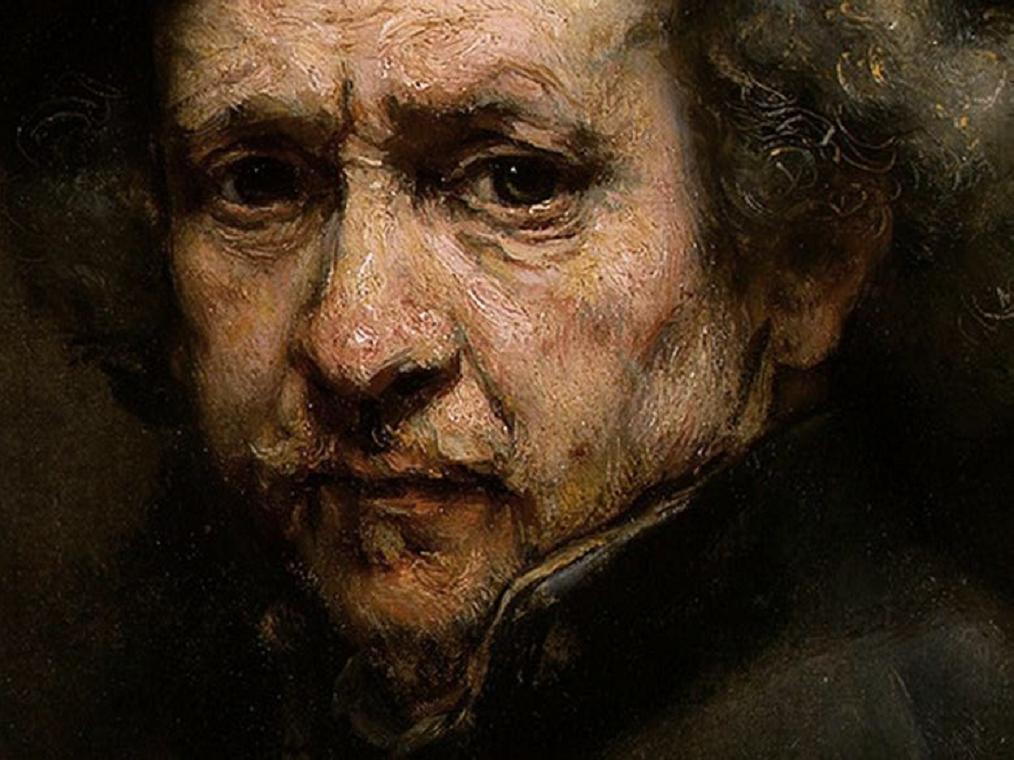
Portrait of an Elderly Man provides a prime example of his new, looser aesthetic. Produced in 1667, the painting features abundant texture, which Rembrandt achieved by applying paint with a palette knife and scratching into the wet rim of the hat, for instance, with his brush handle. Comparing the roughly rendered hands of this disheveled gentleman to the realism of the cadaver’s undissected one in The Anatomy Lesson of Dr. Nicolaes Tulp demonstrates the considerable changes Rembrandt’s style underwent in his later years. Likewise, due to his use of chiaroscuro in Self-Portrait at the Age of 63–completed in 1669, the year of his death–the illuminated face, with heavy impasto, contrasts with the dim, shadowy background. At the time, his coarse, dark portraits were not appreciated as much as elegantly painted ones, but he did continue receiving commissions from patrons who appeared to recognize his unique ability to portray not only the physical aspects of his subjects but also their spiritual essence.


A Provocateur of Emotion
These patrons’ endorsement begs the question, “Although the shift in Rembrandt’s artistic approach coincided with a period of grief and economic strife, did his art become worse or merely different?” I would not only disagree with some of his contemporaries’ distaste for his later works but also elaborate upon the opinion that his new style enhanced many aspects of them, such as their emotional resonance. Specifically, Rembrandt’s self-portraits exhibit brutal honesty about and acceptance of the physical and psychological strains that often come with age as well as the unique struggles he had endured, as exemplified by the wrinkles, puffy skin, and gray hair in Self Portrait at the Age of 63. In his presentation about Rembrandt’s self-portraits for the National Gallery, lecturer James Heard observed, “If you look at some portraits, [they seem to have] almost a smooth mask, and you feel you cannot penetrate beyond that mask. . . . [Y]ou can’t get inside the spirit because of the very smooth way of painting.” Beyond providing a deeper window into his subjects, Rembrandt’s textured paint application encourages viewers to self-reflect and recognize their own mortality.
A Precursor to Aspects of Impressionism
While the young Rembrandt may have enjoyed popularity and economic success, the old Rembrandt not only enhanced emotional engagement with his paintings but also served as a significant inspiration for the Impressionist movement, which began in approximately 1860, nearly two centuries after his death. Impressionists sought to achieve the essence of scenes via loose, lively brushwork, and they left details up to each viewer’s individual interpretation. Similarly, the rough finish and minimal fine details in Rembrandt’s later works invite you to contribute to the painting with the brush of your imagination. Although Impressionist paintings feature bright colors that contrast with Rembrandt’s darker palette, this potential for personal connection, as well as his expressive brushstrokes, is evidence of the beautiful beginnings of Impressionism.
An Inspiration for the Post-Impressionists
From Impressionism arose Post-Impressionism in the late 1880s. Whereas Impressionists focused on capturing the transient effects of light and color, Post-Impressionists, moving away from direct visual observation, aimed to convey subjective experiences, emotions, moods, and psychological states. In short, Impressionists sought to express what they saw in a fleeting moment while Post-Impressionists what they felt.

For instance, Vincent van Gogh conveyed profound emotional experiences via his expressive paint application, an ability that echoes that of Rembrandt; in fact, van Gogh drew much inspiration from him. A letter to his brother Theo states, “What particularly struck me when I saw the old Dutch paintings again is that they were usually painted quickly. That these great masters like Hals, Rembrandt, Ruisdael–so many others–as far as possible just put it straight down–and didn’t come back to it so very much,” an indication that Rembrandt potentially contributed to van Gogh’s propensity for rapid brushstrokes. Van Gogh also wrote, “The best paintings–precisely the most perfect from a technical point of view–seen from close to are touches of colour next to one another, and create their effect at a certain distance. Rembrandt persisted in this despite all the trouble he had to suffer as a result (the worthy citizens thought [Dutch painter Bartholomeus v]an der Helst much better for the reason that one can also see it close to).” Rembrandt’s later works were, in fact, designed to be viewed from a distance from where adjacent dabs of paint blend into larger, highly detailed paintings just as van Gogh’s works were. Evidently, the psychological and emotional profundity of his later works rather than the realism of his earlier ones was what had an enduring influence on art movements, including Impressionism and Post-Impressionism.
Van Gogh’s Prioritization of Emotional Impact
While, as Rembrandt did, van Gogh experienced criticism about his error-ridden figure rendering, the imperfections are highly successful in fulfilling both artists’ less superficial objectives. The Potato Eaters–which van Gogh produced in 1885, the same year he visited the Rijksmuseum and contemplated Rembrandt’s pieces–exhibits his prioritization of emotional impact over visual realism through its quick brushstrokes and slight technical inaccuracies, from the faulty perspective to the elongated arm on the far right. His focus was not technical perfection but rather communicating the brutal realities of country life, as enhanced, not undermined, by the coarse rendering of the peasants’ faces and bony hands, worn from work.

The Significance of Impressionism

Overall, Impressionism marked the divergence from the norm in European art of realism. While the art movements that occurred in Europe before the nineteenth century differed in theme or technique, they all valued realistic representation of subject matter. For instance, Neoclassical paintings depict mythological figures and scenes, but all are rendered in meticulous, accurate detail. Due to the advent of photography, Impressionists recognized that technology was most adept at capturing static images and thus turned their attention to depicting fleeting moments with color, light, and movement in a way that photographs could not replicate. They portrayed reality through the human eye, which perceives moments as transient and sometimes blurred, rather than from a camera lens. Now, some artists valued expressing emotions, impressions, and other aspects of the human experience.
Modernist Art vs. Realism: Which Is Better?

_aP37VUXXeMuZdH
Impressionism is flanked by traditional art and modernist art, which also deviates from faithfully rendered reality. Today, art continues to be viewed as a means of evoking emotion and thought, not just a rendition of reality, yet some hold the misconceptions that modernist art lacks a clear message and that it does not require technical skill. Regarding the first, as we have discussed, divergence from realism, including abstraction, can actually help artists capture their intended message and heighten emotional resonance, for it enables them to convey feelings and concepts that realistic representations cannot. Although I have mentioned a declining focus on technical perfection beginning with the Impressionist movement, we should not assume that modernist artists lack technical skill or talent. Rather, different artistic styles require different forms of technical skill. While modernist art deprioritizes traditional craftsmanship, masterful technical execution in this context involves intentional brushwork and composition, for instance, that facilitate the transmission of an innovative, thought-provoking concept.
To best appreciate modernist art, we should not evaluate it using the standards of classical fine art and should recognize that one art form is not superior. Evidently, artists like Rembrandt, who deviated from many of his contemporaries’ view of technical mastery, did not become worse over time but rather explored a new style . . . one that happened to have a long-lasting effect on subsequent art movements. Moreover, my intention is not to undermine realism, for it and the conveyance of a profound message are not mutually exclusive. The realistic half-peeled lemon, amongst other symbols, in Willem Claesz Heda’s Still Life with Gilt Goblet is a poignant reminder of the transience of life and material pleasures just as Rembrandt’s gestural portrayal of his aging reminds us of our mortality. Therefore, I urge all you aspiring artists–as well as those, such as myself, who simply enjoy making art–to develop the style that best fulfills your artistic aims without fear of judgment.

Sources
- Thank you to our guide in the Netherlands for sharing the information upon which this post is based.
- https://www.thecollector.com/rembrandt-from-rags-to-riches-and-back-again/
- https://www.theleidencollection.com/essays/rembrandt-as-universal-artist/#:~:text=When%20Rembrandt%20died%20at%20age,before%20reached%20(fig%208).
- https://www.youtube.com/watch?v=ENYeIydLtWI
- https://www.vangoghstudio.com/was-van-gogh-inspired-by-rembrandt/
- https://renminds.org/2023/04/18/an-ism-overview-impressionism-vs-post-impressionism/
- https://www.vangoghmuseum.nl/en/collection/s0005v1962
- https://www.thecollector.com/how-photography-transformed-art/
- https://luxuryartcanvas.com/blogs/home-decor/why-is-modern-art-so-bad#:~:text=A%20misconception%20about%20modern%20art,artwork%20rather%20than%20precise%20execution
- Feature image: https://slantbooks.org/close-reading/essays/absorbed-by-rembrandt/