

Introduction
American writer Elbert Hubbard once said, “The supernatural is the natural not yet understood.” Whether you believe that some phenomena are inexplicable or simply require more scientific investigation, Hubbard’s quote raises an interesting question: How has nature sparked cultures’ beliefs about and relationships with supernatural beings?
Holy Figures Associated With Nature
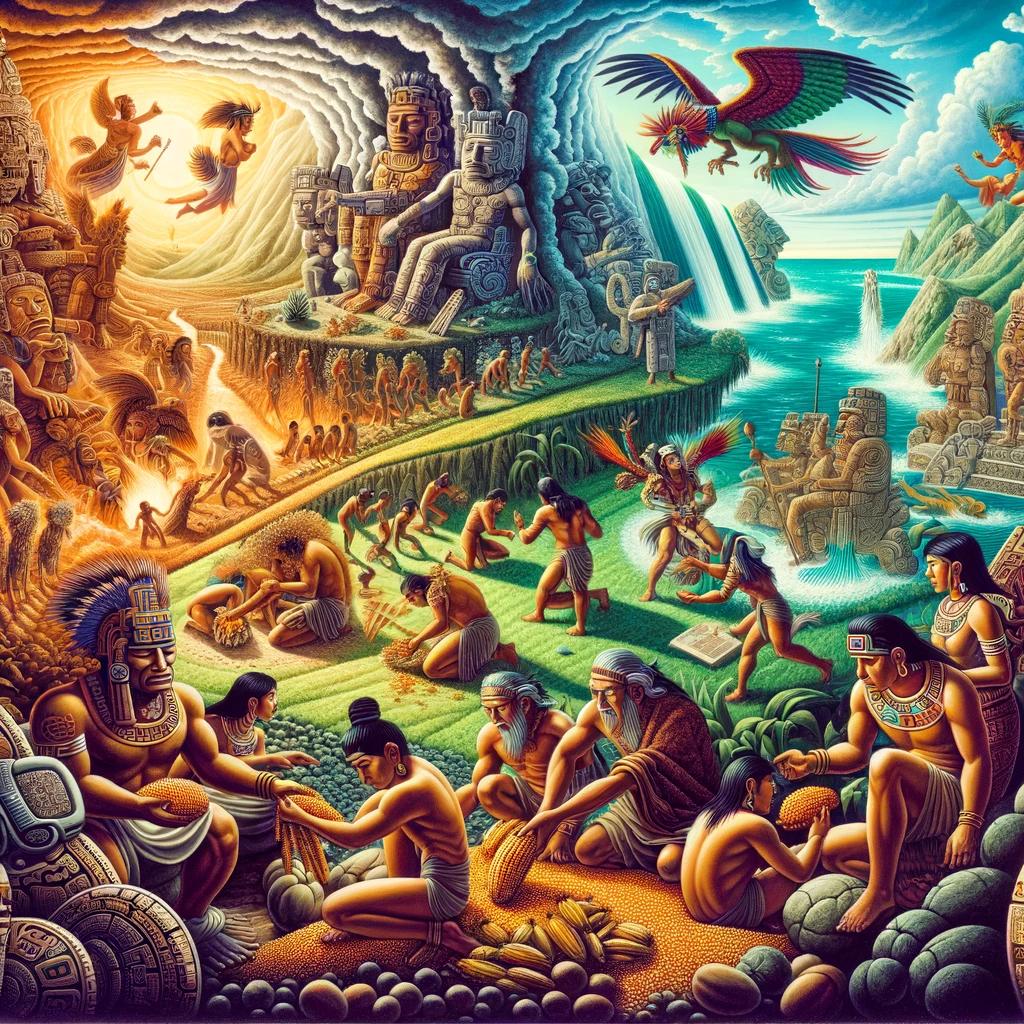
While in Yucatán, I learned that the Maya’s connection with nature is closely intertwined with their connection with the supernatural. They believe that supernatural beings located in both the sky and on Earth control agriculture. For instance, on May 3, before the rainy season, the Maya celebrate the Day of the Holy Cross to usher in the rains necessary for plant growth. The cross is decorated with leaves to represent fertility, and another ritual object, a carved wooden image of the young maize god trying to leave Mother Earth’s womb, serves a similar purpose. I am fascinated by the fact that the maize god’s life cycle symbolizes the agricultural one, for his emergence from Mother Earth into the sunlight is akin to crops bursting through the soil. While you may know the Catholic meaning of the cross, evidently, the Day of the Holy Cross carries a pre-Hispanic significance.

Likewise, Virgins, including the Immaculate Conception and the Assumption, represent the earth’s fertility, and various saints held or hold powers tied to nature. To name a few, Anthony of Padua and other saints initially protected animals, Saint Isidore regulates the rains, and Saint John the Evangelist protects against locusts. A sculpture from Chichén Itzá depicting Kukulkan, a half-reptile, half-bird creature, similarly controlled the natural elements.

Yucatecan Ecosystems: A Biological Exploration of Their Wonders
Las Coloradas
Yucatecan ecosystems are as enthralling when studied from a biological perspective. We were fortunate to learn about the artisanal production process of salt during our time in Las Coloradas. Due to microorganisms that inhabit them, the lakes here undergo color change from green to blue to orange to pink. The orange color results from halobacteria, a type of microalgae that contains abundant beta-carotene. You may have heard that this pigment gives carrots their hue, and it has the same effect on the water.

When the salt is on the verge of crystallization, the high salinity allows only brine shrimp to survive. These small crustaceans eat microalgae and thus purify the lakes, a process that allows more sunlight to penetrate the water, for there are fewer particles to scatter it. In turn, the increased sunlight promotes evaporation, which further crystallizes the salt and raises its concentration to a level unfit for even brine shrimp. Upon death, the crustaceans turn pink and color the water when the bonds between astaxanthin carotenoids, a red pigment, and proteins break.

Mangroves’ Filtration System
To continue playing important roles in their ecosystems as brine shrimp do, Yucatecan organisms have developed adaptations. At the Ría Lagartos natural reserve, I learned that mangroves exhibit an impressive filtration system. Note that this reserve is not a “río,” or river, but rather a “ría,” or estuary, for instead of containing primarily freshwater, it includes both freshwater from rivers and saltwater from the ocean. To survive the saltwater conditions, mangrove species have developed two main methodologies: removing salt from their tissue or preemptively obstructing it from entering their tissue.

Red Mangroves
Red mangroves (Rhizophora mangle) primarily employ the latter approach. Transpiration occurs when excess water absorbed by mangrove roots evaporates through the leaves, primarily the stomata. This evaporation process creates the transpiration pull, a suction force that allows water to travel against gravity, up the xylem, and thus counteract osmosis, for water travels toward an area of lower salt concentration, the xylem sap, rather than higher concentration, the seawater.
Black and White Mangroves
Black and white mangroves generally utilize the former technique, and scientists believe that they take in saltwater from which their leaves excrete salt via glands. Specifically, proton pumps execute active transport by moving sodium against the concentration gradient (from low to high concentration) and into a compartment in the leaf structure. The protons then execute passive transport by moving along the concentration gradient, an action that releases energy so that an ion exchanger also facilitates active transport by moving the cations to an already proton-concentrated compartment. Overall, this process contains sodium ions in specific compartments while the cuticle, which seals off all potential passages but the stomata to control what enters and exits the leaf, prevents both sodium and chloride ions from entering other plant tissues. Its waxy structure enhances its function, for wax is hydrophobic and thus repels ions (as well as polar molecules). Although some ions are able to escape the plants’ cell membranes, the majority gather in microvacuoles, small bubbles in the salt glands, that eventually return salt to the environment. The excretion of salt causes visible salt crystals on mangrove leaves’ surfaces.

Another interesting adaptation is that when the roots–also involved in the filtration system–are exposed to air, they assume a new function: absorbing oxygen essential for aerobic metabolism by opening lenticels, or small pores. Further, mangroves protect fish from predators due to their concealing roots, provide homes for sea creatures, and reduce erosion.
Cenotes
As the Ría Lagartos and mangroves do, the cenotes in Yucatán have long benefitted resident organisms. The meteorite that caused the dinosaurs’ extinction fell near Yucatán and thus caused the peninsula to emerge from underwater. Since the scorching meteorite boiled the water, bubbles formed that ultimately resulted in holes. Thus, Yucatán is said to resemble cheese! Initially, these holes, or cenotes, were covered, but erosion and rains have caused some to partially or fully open. The Maya living in Chichén Itzá, for instance, lacked water sources at the surface, for even in the current-day region, freshwater is located underground, beneath a thin covering of arable rocky soil. Without rivers or lakes, there was only saltwater, for as mentioned, even estuaries, like Ría Lagartos, lack pure freshwater. Thus, the cenotes served, and continue to serve, as a critical clean water source that visitors must avoid contaminating with sunscreen or insect repellent.

Beyond their practical purposes, cenotes held religious significance that also mandates respectful and careful treatment of the fragile ecosystems. The Maya involved cenotes, supposed entrances to the underworld, in rituals during which they interacted with deities and ancestors via human sacrifices as well as offerings aimed at securing prosperous crops and general well-being. Ceremonies featured dances and music to connect with supernatural beings in addition to strengthening the community and young generations’ cultural identity.
Meliponas: the Royal Lady Bee
Another crucial player in Yucatecan ecosystems is the bee. Besides the stinging bees with which I was familiar, there are non-stinging bees on the peninsula that are actually endemic: meliponas, or Xunán Kab in Mayan. Unfortunately, since they are small and produce little honey, they are often overpowered by stinging bees when competing for food and are thus endangered, a status exacerbated by deforestation, amongst other factors. Specifically, while a stinging bee, twice as large as a melipona, can produce as much as 30 liters of honey annually, a melipona bee provides only one-and-a-half liters.

Despite these hardships, melipona bees are highly valued in Yucatán–hence the translation of their Mayan name to “royal lady bee”–for while regular honey can moisturize skin and heal wounds, that of meliponas has double the remedial value because these bees select medicinal plants to pollinate. The scent of their wax also has the power to alleviate asthma. After sampling varieties of honey, we even tasted pollen produced by meliponas, which I soon learned is paired with ingredients such as yogurt due to its high protein; in fact, its protein value is 50% higher than that of the pollen produced by other bees, a property that increases agricultural yield. The pollen is also used as a payment and offering during rituals. More generally, meliponas feature in numerous Maya religious practices because they are believed to be spiritual beings protected by the god Ah Muzenkab.

To preserve the precious meliponas and other bees, our guide through Apiturismo Sinanche recommended notifying professionals to safely remove them from homes instead of using insect repellent, for instance. Learn more about how to support conservation efforts here.

Conclusion
As this blog explores, biology and culture are intimately connected in that they both often underlie phenomena from the obesity epidemic to mate selection. However, through our travels to Yucatán, I have discovered another reason why they tend to be intertwined: throughout history, cultures have been shaped around unique explanations of mysterious biological occurrences. Thus, as you interact with flora and fauna across the globe, treat them with the reverence that their cultural in addition to practical significances warrant.
Sources
- Thank you to our guides in Yucatán for sharing the information upon which this post is based.
- https://www.mpm.edu/research-collections/anthropology/online-collections-research/lake-amatitl%C3%A1n-guatemala-collection-2#:~:text=The%20greatest%20ceremony%20during%20the,ritual%20designed%20to%20bring%20rain.
- https://www.nhmi.org/mangroves/phy.htm#:~:text=The%20Red%20mangrove%20is%20a,occur%20at%20the%20root%20surface.
- https://asknature.org/strategy/glands-remove-excess-salt/
- https://thecenoteguy.com/how-cenotes-shaped-the-ancient-maya-civilization/#:~:text=Cenotes%20Today-,Religious%20and%20Ceremonial%20Significance,offerings%2C%20sometimes%20even%20human%20sacrifices.
- https://pischanrestaurant.com/discover-the-sacred-bee-of-the-mayas/?lang=en