
Introduction
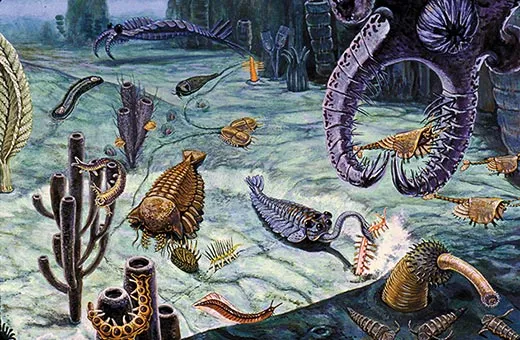
What if the history of life is not a story of predictable linear progress and expansion through time but rather of luck and decimation, and how can a shale deposit tucked in the Canadian Rockies help expose this reality? These questions and many more guide today’s post, centered on the Burgess Shale.
A Fossil Deposit That Changed Evolutionary History

Here, soft anatomy is captured in remarkable detail, an anomaly in the fossil record. While rare, the preservation of soft-bodied organisms offers a vital glimpse into the true diversity of ancient life, given that most animals do not possess hard parts and that even the shells or exoskeletons of those that do often reveal little about the creatures’ full anatomies. Why does the Burgess Shale serve as such a complete window into the burst of diversification during the Cambrian explosion? Seemingly, the oxygen-poor sediments or presence of clay minerals prevented decay when living and deceased animals were rapidly buried.
The Burgess Shale Reveals a Lost World of Possibilities
Upon discovering the Burgess fauna in 1909, paleontologist and scientific administrator Charles Doolittle Walcott interpreted it as merely a set of primitive versions of later, more advanced forms. However, in reality, fifteen-to-twenty Burgess species cannot be assigned to known phyla, and even amongst those that can, the anatomical range extends far beyond that of modern species. These revelations imply a striking truth about the history of life: rather than unfolding as a steady progression toward greater excellence, complexity, and diversity, it began with the maximum breadth of anatomical variety, followed by elimination and differentiation within the few surviving branches. You may be wondering, “Doesn’t today’s Earth host more species than ever before?” Yes, it does, but most are variations of a limited set of basic anatomical designs. In contrast, the Burgess fauna included far fewer species but exhibited far greater disparity in body plans. Overall, we must distinguish between diversity, or number of species, and disparity, the variety of body plans.
Why Did So Many Body Plans Appear So Quickly?

Let’s further examine the two major insights into life’s history revealed by the reinterpretation of the Burgess fossils: the rapid emergence of extraordinary anatomical range and the subsequent differential survival. Three major explanations have been proposed for the former, the first of which revolves around the claim that the Cambrian explosion was the initial filling of the “ecological barrel” for multicellular life, which thus had nearly unlimited opportunities to radiate into empty niches while encountering minimal competition.
This disparity may also reflect intrinsic differences between Cambrian organisms and those of later times. Perhaps Cambrian genomes were inherently simpler and more flexible, or more capable of producing radically new body plans; there were fewer interactions amongst genes; their gene-to-product translation was more direct; and/or their developmental processes were less constrained, so they allowed for major evolutionary changes.
A third explanation views Burgess disparity as reflective of a general property of evolutionary systems rather than of special ecological or genetic circumstances. When the first species were placed randomly on the evolutionary “landscape,” large “jumps” had a fair chance of resulting in new body plans, represented by landing on higher “peaks.” However, as they became occupied, the likelihood of successful jumps declined, so more recent evolution produces variants of a few surviving designs rather than entirely new body plans.
Survival Is Not Always a Measure of Superiority
Now onto what determined which forms would persist versus perish as Burgess disparity dwindled. The traditional view of survival is that it depends upon inherent superiority, complexity, or proximity to humans, but this misconception cannot account for the randomness evident in mass extinctions, for instance. In reality, organisms may owe their survival to chance.
Why We Continue to Believe in Evolutionary Progress
Although the Burgess revision has illuminated both the rapid, early origin of disparate life and the role of contingency in survival, iconographies continue to distort our understanding of evolution by supporting Walcott’s erroneous interpretation of the fossils. What perpetuates our misconceptions? Unfortunately, a desire to maintain the comforting illusion of human superiority and inevitability. To do so in a world that operated without us until extremely recently in geological time, we must view all prior life as laying the groundwork for our eventual existence.
For instance, the ladder of progress implies that evolution follows a single, linear trajectory culminating in humans and thereby warps the very definition of “evolution” so that it becomes synonymous with “progress.” Even when we recognize that life branches into a bush rather than progressing linearly, the tree of life we depict, the cone of increasing diversity, reinforces our desire for predictable progress. This model presents life as beginning restricted and simple before expanding toward greater diversity and, by implication, toward improvement.


Evolution Is Better Explained by Decimation Than Progress
How would you more accurately portray early evolution as an initial rush of diversification, generating the maximum range of anatomical possibilities, followed by widespread decimation, or the selective survival of a few designs? One revision essentially inverts the cone of increasing diversity by featuring extensive early branching before branches are lost and surviving models further diversify. While the ladder and cone suggest a fixed evolutionary pathway, this model of decimation and diversification instead implies contingency. Since each evolutionary outcome depends upon countless, improbable prior events, if the tape of life–an analogy employed by paleontologist and evolutionary biologist Stephen Jay Gould–were replayed, small early changes could redirect evolution along radically different pathways. Consequently, no particular end, including our own species’ existence or intelligence, could have been predicted.
Mammalian Dominance Was Never Guaranteed

Even prior to the origin of Homo sapiens, the dominance of mammals more broadly was not preordained. Mammals appeared in the late Triassic, alongside or shortly after the first dinosaurs, and for the next hundred million years, they remained marginal, small-bodied creatures in a dinosaur-dominated world. During this time, there was no indication that mammals were on a trajectory toward hegemony; dinosaurs continued to dominate nearly every environment for large-bodied terrestrial animals while mammals made no significant gains in body size, brain size, or ecological influence. Their later success, following the dinosaurs’ abrupt extinction by an extraterrestrial impact, was far from predictable. Without that random cosmic disaster, dinosaurs would likely still reign over large-bodied vertebrates, and mammals would remain inconspicuous. Given that dinosaurs showed no trend toward larger brains and that such an outcome might have exceeded reptilian developmental limits, consciousness would not have evolved. This thought experiment reiterates that we have sheer luck to thank for our existence as reasoning, large-bodied mammals.
Contingency Shapes Lives as Well as Species!
At the individual in addition to species level, I am sure we can all point to examples of contingency in our own lives, and one that comes to my mind involves my mother. She had hoped to secure a position at a prestigious management consulting firm, but during the interview, her mind went completely blank, and she did not get the offer. At the time, the rejection appeared to be a significant setback. Yet, her subsequent acceptance of a role at a different company proved fortuitous. The environment enabled her to cultivate decision-making skills, acquire operational experience, develop resilience, sharpen strategic judgment, learn to work comfortably under pressure, and engage with senior leaders. These experiences ultimately prepared her for her current position as a business leader. In this way, an unanticipated turn profoundly shaped the rest of her trajectory just as contingent evolutionary events have transformed the history of life.
Sources
- Wonderful Life: The Burgess Shale and the Nature of History by Stephen Jay Gould
- Feature image: https://www.smithsonianmag.com/history/burgess-shales-weird-wonders-36404411/