
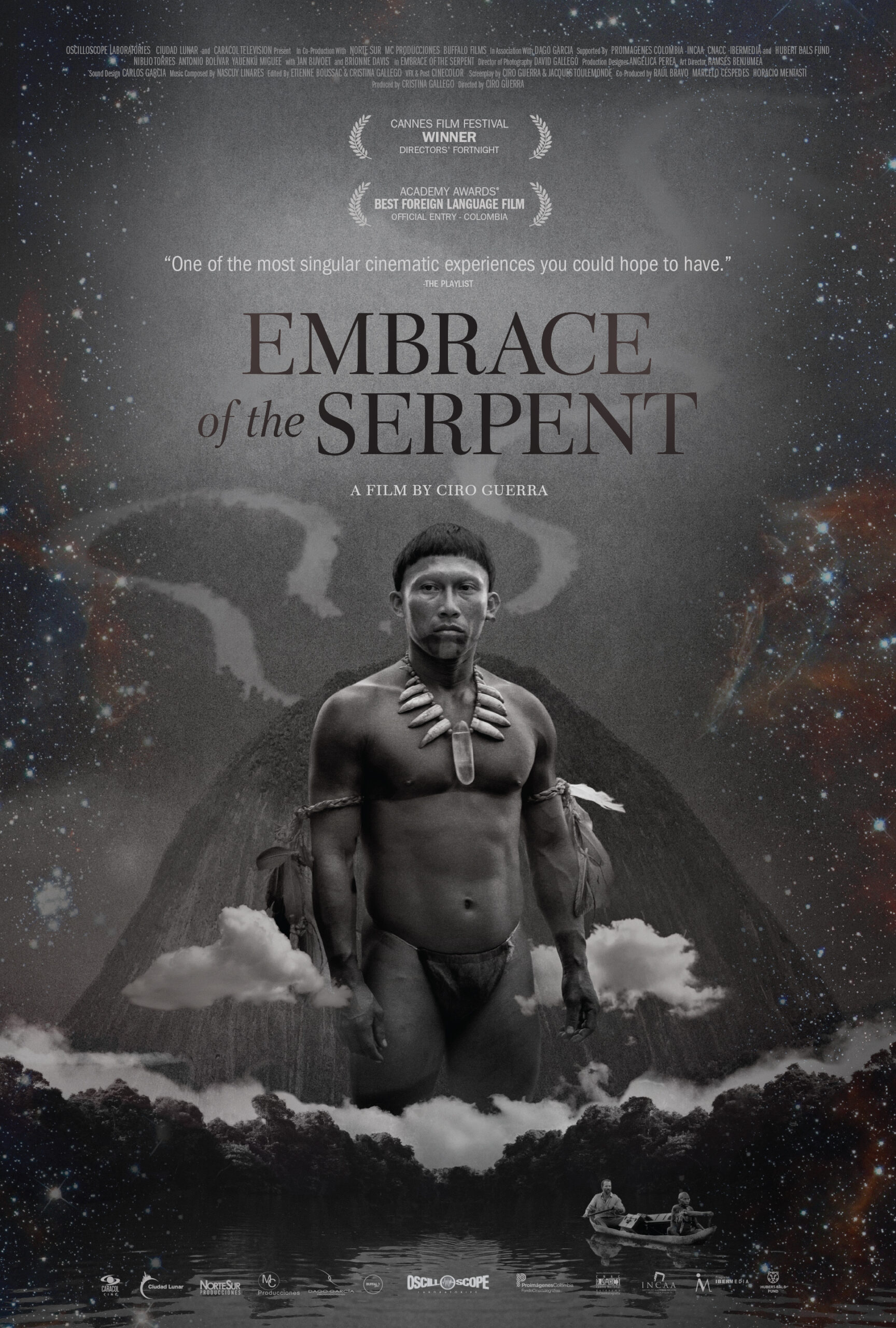
Material Records Cannot Preserve Living Knowledge

By contrasting Theo’s refusal to abandon his luggage, which reflects his attempt to preserve Indigenous knowledge as material records for Western validation, with Evan’s willingness to discard his possessions and develop a spiritual relationship with the environment, Embrace of the Serpent demonstrates that Indigenous knowledge survives not through detached documentation but through transmission to Westerners willing to participate actively in its spiritual continuity. When Karamakate advises Theo to “[l]eave all [his] luggage,” Theo’s rebuttal, “I have to keep [these boxes], otherwise nobody will believe me,” reveals his dependence on Western validation; without physical records to present to a Western audience, he fears his lived experiences will lose legitimacy within his cultural system of knowledge. In contrast, Karamakate dismisses the belongings as “just things” and thereby challenges Theo’s assumption that material records give his journey meaning by preserving knowledge. His question “Why do you whites love your things so much?” further suggests that Theo’s attachment stems not from practical necessity, as Theo believes, but from a culturally shaped worldview that treats objects as sources of authority and proof. Karamakate’s demand that Theo abandon his luggage therefore urges him to relinquish not only its physical burden but also the belief that Indigenous knowledge can be preserved through detached observation embodied in material records rather than lived spiritual experience. Karamakate’s rejection of material proof as a means of preserving Indigenous knowledge is further demonstrated when he examines photographs of Theo and himself and deems them chullachaquis, bodies devoid of memory and soul that he describes as “empty” and “hollow.” By identifying photographs as lifeless copies that reproduce only external form while lacking spiritual essence, Karamakate rejects the Western assumption that such records can faithfully preserve reality. These moments reflect Theo’s ultimate failure to support the meaningful survival of Indigenous knowledge, as his efforts prioritize producing material records rather than sustaining its spiritual continuity through the development of a spiritual relationship with the environment. Although his journals reach Germany, they preserve only a representation of Indigenous culture severed from the living spiritual system that gives it meaning and continuity.
Spiritual Participation Enables Cultural Transmission

In contrast, Evan’s willingness to abandon his possessions enables the spiritual transformation Theo cannot achieve, which allows him to become a participant in the spiritual continuity of Indigenous knowledge rather than merely its recorder. When Evan asks Karamakate, “Will you show me the way [to the yakruna]?,” he responds, “I don’t know it. It is for you to find out. Throw away your luggage,” an exchange that reveals that the “way” to the yakruna and the sacred knowledge it represents is not a fixed physical path but a process of inner transformation. By requiring Evan to throw his luggage into the water, Karamakate further indicates that this transformation cannot be achieved through material tools of scientific observation, which position the Westerner as a detached interpreter of knowledge, but only through spiritual participation. The juxtaposition between the two men is reinforced by the river’s differing behavior in each scene. As Theo struggles to carry his belongings, the rushing water and loud current suggest his resistance to the environment’s embrace, a resistance stemming in part from the objects that bind him to his role as a Western observer. The calmer water that receives Evan’s discarded belongings indicates that by giving up material attachments and becoming receptive to the environment’s spiritual guidance, he enters into a harmonious relationship with it, which enables him to internalize and transmit Indigenous knowledge.
The Survival of Indigenous Knowledge May Depend on Cross-Cultural Transmission
Karamakate’s decision to entrust Evan with Cohiuano knowledge suggests that he ultimately recognizes the truth in Manduca’s assertion that the survival of Indigenous cultures may depend not on complete resistance to Westerners but on the transformation of Western understanding. Despite Manduca’s claim that “[Theo] can teach the whites. . . . If we cannot educate the whites, it will be our end,” I shared Karamakate’s initial skepticism and assumed sharing Indigenous knowledge would reproduce colonial exploitation. This reaction was shaped in part by my mother’s witnessing the disruption of African Indigenous Education, which Western institutions dismissed as primitive. However, Evan’s transformation challenged my and Karamakate’s assumptions by demonstrating that cross-cultural transmission does not inevitably result in domination when Westerners approach Indigenous knowledge with humility. Ultimately, I realized that although individuals are shaped by their cultural and historical contexts, they are not confined by them and can carry forward ways of knowing beyond their cultural origins.
Imposed Transformation Produces Spiritual Emptiness

Karamakate’s encounter with the mission community, stripped of Indigenous spiritual foundations and trapped within a distorted imitation of Western religion, serves as a counterpoint to this possibility of successful knowledge transmission by illustrating the consequences of spiritual transformation imposed through domination rather than organically received. The Messiah’s declaration “Sacred plants? The only thing sacred in this jungle is me!” reveals the replacement of an environment-centered spirituality with human authority. He departs from Christianity in addition to Indigenous beliefs by perverting the Eucharist. He commands his followers to “[t]ake and drink” his blood not as a symbolic act of sacrifice but as an assertion of his divine authority, as evidenced by his prideful joy when Evan calls him the “Son of God” and his self-bestowal of additional titles of authority, such as “Messiah” and “Redeemer of the Indians.” This transformation of a ritual of humility and self-sacrifice into a tool of control reveals that spiritual systems, when imposed as instruments of subjugation, produce spiritual emptiness rather than continuity.
Sources
- https://www.swank.com/digital-campus/details/27663-embrace-of-the-serpent
- Feature image: https://www.imdb.com/title/tt4285496/