
Introduction
Bolivia’s education system has long illuminated broader struggles over identity, power, and nationhood. Historically, education functioned as a tool of assimilation through castellanización, the imposition of Spanish language and culture on Indigenous populations. However, resistance to this model has similarly deep historical roots. Beginning in the 1970s, intellectuals and activists articulated critiques of the exclusionary nation-state. This movement gained momentum with Bolivia’s return to democracy in 1982 after nearly two decades of military rule, as Indigenous organizations mobilized culture as a form of political power. Over time, Indigenous groups consolidated into a distinct political community advancing demands for not only cultural recognition but also structural change. As this mobilization intensified, the state responded through formal reforms, including the 1994 education reform, which introduced intercultural bilingual education (IBE) within a neoliberal framework, a shift toward recognizing Bolivia’s cultural diversity.

However, Bolivia’s severe economic crisis during the democratic transition and the social costs of neoliberal restructuring created widespread dissatisfaction with governance. Although reforms backed by institutions such as the International Monetary Fund (IMF) stabilized the economy, they also exacerbated poverty, unemployment, and inequality while the coca-cocaine economy became an essential economic safety net for many Bolivians. As a result, counterdrug policies led by the United States and the militarized “war on drugs” were often perceived as forms of foreign intervention that threatened Bolivian sovereignty and subordinated local priorities to external interests. In this context, the 1994 education reform was widely criticized as another imposed neoliberal project, as its design and implementation were closely tied to international financial institutions and it was crafted by largely external consultants and central government officials rather than through sustained grassroots participation. These tensions in education reform underscored a broader continuity: although Indigenous inclusion within the state was expanding, it remained embedded in political and economic structures that limited the translation of participation into genuine redistribution of power.

Such dissatisfaction with neoliberal governance helped fuel the rise of Indigenous social movements in the early 2000s, which culminated in the 2005 election of Evo Morales, Bolivia’s first Indigenous president. Due to his background as a union leader for coca growers, Morales opposed foreign drug enforcement intervention. Under his administration, coca policy shifted away from coercive U.S.-backed eradication toward negotiated reduction, local participation, and economic development.1 These changes carried not only socioeconomic but also symbolic significance for Indigenous communities, for whom coca served as a marker of cultural identity. As a result, the policy reinforced perceptions that the Morales government was recognizing and defending Indigenous cultural practices while advancing a more autonomous approach to policymaking than previous U.S.-influenced drug control strategies. For many Indigenous organizations, their leaders, and their community base, developments such as these also suggested that Morales was capable of advancing a broader project of structural transformation, potentially including the reconstruction of the state to reflect its Indigenous roots. Education reform was positioned as a central mechanism of this transformation, and at its heart was the Avelino Siñani-Elizardo Pérez (ASEP) reform, framed as a rejection of externally imposed neoliberal policies.
Despite the increased involvement of Indigenous groups in national politics, the extent to which Morales’ reconfiguration of the Bolivian state amounted to genuine transformation by redistributing power and expanding Indigenous autonomy remains contested. Marxist scholars Marta Harnecker and Federico Fuentes argued that Morales facilitated a profound structural transition by shifting Indigenous and peasant movements away from a defensive strategy of reactive protest toward an offensive campaign to capture state power. Moreover, they contend that his administration challenged the regional capitalist order by reclaiming national sovereignty over natural resources and reducing the dominance of transnational corporations over national wealth. Critics, however, emphasize the continuity of pre-existing power structures. For instance, Bolivian sociologist and critic of state-led decolonization Silvia Rivera Cusicanqui asserts that Morales’ government merely put an “Indian face to corporate capitalism,” a “disguise” that masked the persistence of centralized state power and left deeper political, economic, and cultural structures of the colonial state largely intact. Both perspectives capture important dimensions of Morales-era reforms but tend to understate the coexistence of continuity and meaningful political, institutional, and ideological change.
This paper argues instead that while centralized state power persisted, an exclusive emphasis on that continuity obscures the significant changes in discourse, recognition, and participation brought about by the reforms. In fact, some of the continuities that limited the reforms’ transformative potential–particularly conflicts over the meaning and implementation of decolonization–were intensified by resistance to Indigenous-centered reforms. Their persistence therefore suggests that the absence of structural transformation reflected not only enduring power structures but also the opposition generated by a consequential process of political and ideological reconfiguration. Examining education reform, specifically, provides a useful lens through which to assess the possibilities and limits of decolonization in Bolivia. As a primary arena in which decolonizing ideals were translated into institutional practice, it reveals how efforts to transform state-Indigenous relations generated both meaningful reconfiguration and enduring constraints. Overall, although framed as a domestically driven, ideologically transformative project that recast education as a vehicle for social justice and fostered perceptions of broad state transformation, Morales’ “Indigenous state,” particularly as expressed through ASEP, neither transformed nor simply reproduced neoliberal or colonial structures but instead reconfigured them. While Indigenous participation remained mediated through centralized state authority and structural constraints exacerbated implementation challenges, ideological conflicts surrounding the reform not only contributed to uneven implementation but also highlighted the significance of the changes ASEP introduced. ASEP therefore meaningfully expanded Indigenous recognition and participation and reshaped political discourse without fundamentally redistributing power.
ASEP and the Promise of a New Indigenous State

Initially, Morales-era education reform was widely perceived as a decisive break from Bolivia’s colonial and neoliberal past, for it repositioned education as a central instrument of decolonization, social justice, and reconstruction of the broader state. At its public launch, ASEP was described as a law “created by Bolivians, and not by the World Bank or the IMF,” in direct contrast with the 1994 education reform, widely criticized as externally imposed. By recasting education as a nationally driven project deemed “liberadora, revolucionaria, [y] anti-imperialista,” ASEP portrayed itself not as merely reform but as rupture with Bolivia’s colonial and neoliberal past. Education was elevated to what the government described as the “highest function of the state,” with teachers positioned as “soldiers of the liberation and decolonization of Bolivia.” Such language signaled a move beyond the technocratic and developmental framing of earlier reforms toward an explicitly political and ideological project.2 This ideological shift was expressed in ASEP’s emphasis on decolonization, defined by the Congreso Nacional de Educación 2006 as “putting an end to ethnic borders that influence opportunities in the area of education, work, politics and economic security, where no one is privileged on the basis of race, ethnicity and[/]or language.” That decolonization avoided “favouring conceptualisations of the Western world as if they are universal” and “valu[ed] the knowledges, skills and technologies of the Indigenous civilisations” appeared to reject the dominance of Western knowledge and constitute a significant break from education’s historical role as a tool of assimilation in Bolivia. While another pillar of ASEP, intra- and interculturalism with plurilingualism, built upon the 1994 reform’s emphasis on IBE, its reframing of IBE through a decolonial lens and connection to intraculturalism reinforced perceptions of ASEP as an ideologically transformative project. Under the 1994 model, interculturalism focused on largely bilingual education and communication between Indigenous and Spanish-speaking populations without fundamentally challenging existing power hierarchies. In contrast, ASEP recast interculturalism as a means of reshaping those hierarchies, and moreover, intraculturalism emphasized the strengthening of Indigenous identities, languages, and knowledge systems from within. These principles positioned education not simply as a space of cultural inclusion but as a mechanism for restructuring historically unequal power relations.
Furthermore, these apparent developments in education seemed to form part of a wider sociopolitical transformation occurring under Morales. Indigenous identity, after having been marginalized within the Bolivian nation-state, was revalorized as a central axis of political life. This shift became visible through Morales’ public embrace of Indigenous identity and the increased presence of Indigenous languages, dress, and leadership within state institutions, which contributed to a widespread sense that the state was being reshaped from within. Many Indigenous citizens described the growing presence of Indigenous identities within state institutions as opening previously inaccessible spaces and allowing them to participate more confidently in public institutions, including schools and universities but also government offices. Simultaneously, social and economic policies contributed to poverty reduction and the growth of an Indigenous middle class, further reinforcement of the impression that deep structural change was taking place. Interpreting these developments as primarily symbolic incorporation reinforcing centralized state power, as critics such as Cusicanqui contend, risks overlooking the extent to which they reshaped political discourse, expanded Indigenous participation, and altered perceptions of who could legitimately occupy and influence state institutions. Overall, the rejection of external imposition, a radical shift in decolonizing and anti-imperialist discourse, the redefinition of education’s purpose, and the broader revalorization of Indigenous identity and participation under Morales generated not only a perception of transformation but also meaningful, if limited, forms of change.
Participation Without Autonomy: The Persistence of Centralized Power
Although Cusicanqui’s emphasis on centralized state power does not fully account for the outcomes of Morales-era reforms, it provides a useful starting point for understanding why perceived strides toward structural transformation ultimately fell short of their ambitions. Even Indigenous actors who appeared to be central participants in the reform process operated within highly centralized institutional structures that constrained the extent to which participation yielded genuine autonomy. In this way, ASEP did not break from a historical trajectory in which the Bolivian state incorporated Indigenous populations without relinquishing centralized authority. From the founding of the republic in 1825 through 1994, state-building projects promoted a homogenizing national identity that marginalized ethnic and linguistic differences.3 Although the 1994 education reform appeared to depart from this trajectory, it reproduced similar dynamics in new forms. Institutions such as the Originary People’s Education Councils (CEPOs) and local school councils initially expanded Indigenous involvement in educational decision-making. Indigenous actors gained visibility within the Ministry of Education, and new channels of participation emerged at local and national levels. However, by integrating Indigenous organizations into formal state structures, the reform gradually reoriented their role from autonomous actors to institutional participants operating within state-defined parameters. These power dynamics persisted under Morales despite ASEP’s framing as a decolonizing and participatory project, and in fact, it reinforced a unified national education system and consolidated decision-making within the Ministry. Over time, the influence of organizations such as the CEPOs declined as policy direction became more standardized and centrally coordinated. In this way, as Cusicanqui argues, the capacity of Indigenous actors to operate independently of centralized state authority remained constrained, and ASEP therefore did not fundamentally redistribute power.
Competing Visions of Decolonization and Indigenous Inclusion
Interculturality as a Site of Political Conflict
While Cusicanqui’s critique helps explain why expanded participation did not translate into greater Indigenous autonomy, fully understanding ASEP’s limited realization as structural transformation also requires accounting for tensions between Indigenous advocates of transformative change and those who resisted or struggled to implement aspects of the reform. For instance, the meaning of social justice remained deeply contested between Indigenous movements and historically dominant creole-mestizo sectors under the Morales administration. On one hand, these disputes reveal the persistence of unresolved ideological divisions that hindered the reform’s implementation. On the other, the intensity of the conflicts suggests that the reforms reshaped political discourse in ways substantial enough to provoke resistance, an indication that processes of reconfiguration cannot be reduced to the continuity emphasized by Cusicanqui. The tensions were rooted in earlier debates surrounding interculturality, which emerged during Bolivia’s return to democracy. While interculturality sought to recognize linguistic and cultural diversity and move away from a homogenizing, mestizo-centered national model, its translation into public policy proved conflictive. For Indigenous actors, interculturality quickly evolved beyond an educational strategy into a broader political project. Rather than signifying mere inclusion, it became closely tied to demands for decolonization, collective rights, restructuring state power, and challenging the historical dominance of creole-mestizo sectors. In contrast, many creole-mestizo sectors interpreted interculturality far more narrowly; they tended to frame it as a mechanism for promoting tolerance and inclusion within the existing national framework as opposed to a vehicle for structural change. From this perspective, the emphasis on decolonization appeared excessive, politically charged, or even exclusionary in its perceived privileging of Indigenous identities and epistemologies. It raised concerns about national cohesion and the prioritization of particular identities over a shared national identity.
Constitutional Reform and the Limits of Indigenous Authority

During the Morales era, these long-standing ideological divisions intensified as constitutional reforms aimed to institutionalize plurinationalism and expand the constitutional recognition of Indigenous self-governance. The initial Constituent Assembly draft of Bolivia’s 2009 Constitution, strongly influenced by Indigenous organizations allied with MAS, envisioned a substantially broader Indigenous jurisdiction than that ultimately adopted in 2009; it proposed that Indigenous authorities exercise jurisdiction over “all types of legal relations” within their territories. Creole-mestizo opposition to the plurinational project, rooted in the long-standing disagreements over interculturality and the extent of Indigenous inclusion, grew as constitutional reforms moved beyond cultural recognition to grant Indigenous peoples greater political and legal authority. Amidst escalating conflict over the constitutional process, negotiations between MAS and opposition forces ultimately yielded a revised constitutional settlement. Rather than constitutionally defining the precise scope of Indigenous jurisdiction, Articles 191 and 192 left both the boundaries of Indigenous judicial authority and its relationship to other legal systems to a future Jurisdictional Demarcation Law. Therefore, they created an opening through which subsequent legislation could substantially restrict Indigenous jurisdiction. The resulting 2010 Law of Jurisdictional Demarcation excluded Indigenous courts from exercising jurisdiction over numerous criminal, civil, and international matters and subordinated Indigenous justice to the ordinary judicial system. As a result, the transformative aspirations of the original constitutional project were constrained by compromises embedded within the constitutional framework and reinforced through later legislation. Yet, the very need to moderate Indigenous-centered proposals in response to resistance from creole-mestizo sectors and other opposition groups suggests that the Constitution’s limitations stemmed from not only enduring power structures but also from meaningful efforts to expand Indigenous authority. The significance of these disputes extends beyond constitutional reform, as the broader conflicts surrounding decolonization and Indigenous authority also shaped the implementation of ASEP.
Teacher Resistance and the Challenges of Educational Transformation
Resistance Before Morales: The Persistence of Assimilationist Educational Practices
Specifically, the translation of the reform’s objectives into educational practice was undermined by unresolved ideological resistance within the teaching profession. As with creole-mestizo sectors, teachers’ resistance predated Morales and was already embedded in the implementation of the 1994 reform. While this reform aimed to establish full bilingualism and elevate Indigenous languages as equal mediums of instruction, many teachers continued to apply a transitional model that prioritized Spanish and limited Indigenous language use to the early years of schooling. This gap between policy and practice exposed the persistence of internalized colonial assumptions within the teaching profession, as teachers, tasked with implementing decolonizing reforms, had themselves been shaped by the systems those reforms sought to transform. Many, particularly Spanish-speaking educators with limited connection to Indigenous communities, resisted pedagogical changes that required not only new methods but also a redistribution of cultural authority toward Indigenous communities. The creation of institutions such as the CEPOs further challenged traditional teacher authority and generated tensions between educators and Indigenous actors, as they were designed to represent the main language groups served by IBE programs and expanded community participation in education.
Colonial Legacies Within the Teaching Profession
These challenges persisted and, in some respects, intensified under ASEP due to ideological opposition to rural- and Indigenous-focused changes. Although teachers’ incomplete implementation of decolonizing education represented another continuity, this resistance resulted from not only enduring structural constraints but also the reform’s elevation of Indigenous perspectives within the education system. Regarding the structural continuity, insufficient training, resources, and institutional support constrained teachers’ ability to adopt new pedagogies and thereby reduced the reform’s transformative ambitions to uneven and fragmented practices. Moreover, beyond teachers’ capacity to implement the reform, their limited willingness to do so partially stemmed from another structural constraint: the failure to achieve meaningful teacher participation in ASEP’s design. While the government framed the reform as participatory and positioned teachers as “soldiers” of decolonization, many educators experienced it as another top-down initiative and felt excluded from meaningful decision-making processes, as participation was often confined to higher-level union representatives.
However, these structural constraints alone cannot fully explain patterns of resistance, as is evident when the perceptions of participatory exclusion are examined across different educational constituencies. For some teachers, particularly in urban and non-Indigenous contexts, who already viewed ASEP as exhibiting rural and Indigenous bias, the lack of participatory parity reinforced perceptions that the reform privileged certain identities and perspectives and complicated its claim to inclusivity. Such criticisms are significant because they suggest that resistance was directed at not only the reform’s top-down implementation but also its efforts to center Indigenous knowledge, identities, and experiences within the educational system. This response indicates that meaningful changes in educational priorities coexisted with the continuities that constrained ASEP’s transformative potential. Specifically, one urban teacher trainer’s characterization of ASEP as “not a Bolivian law, but a law for the Andean world” supports that many urban and lowland teachers felt excluded from the reform process and perceived ASEP as reflecting primarily Andean Indigenous perspectives. In contrast, rural unions were generally more supportive of ASEP, partly because they had been more directly involved in shaping the reform and viewed it as aligned with their broader struggles for recognition and political inclusion. The feeling of exclusion generated by these regional divisions discouraged the implementation of ASEP. Since some teachers continued earlier reform practices, particularly transitional bilingual models, and others reverted to more traditional approaches, there was significant variation in intercultural and plurilingual education across regions and schools. Overall, the uneven implementation of ASEP, partly a reflection of resistance to its Indigenous-centered vision, indicated that the reform had elevated Indigenous perspectives and reshaped educational priorities even without fundamentally redistributing power or transforming underlying structural constraints.
Conclusion
Ultimately, ASEP reveals that the limitations of Morales-era decolonization in education stemmed from not only centralized state power and enduring structural constraints but also from the conflicts generated by efforts to advance Indigenous-centered forms of recognition, participation, and authority. While education reform remained constrained by competing visions of Indigenous-state relations that hindered more fundamental change, it nevertheless elevated Indigenous identities, perspectives, and claims. The result was neither rupture that dismantled existing state frameworks nor stasis but a contested process of political and ideological reconfiguration. Recognizing both the possibilities and limits revealed through education reform is important for understanding the broader Morales-era state because the tensions evident in ASEP between decolonizing ambitions and enduring power structures were not confined to education or constitutional reform but also shaped other state policies. Conflicts such as the TIPNIS dispute, in which plans to construct a highway through Indigenous territory exposed tensions between decolonizing commitments and state-led development priorities, demonstrated that national development objectives frequently overrode Indigenous autonomy and territorial claims. Similarly, the government’s continued reliance on extractive economic policies, which often harmed Indigenous communities, particularly in lowland regions, suggests that centralized economic priorities could take precedence over the principles of autonomy and self-determination the Morales administration espoused.4 These tensions reinforce the central lesson of ASEP: reform expanded Indigenous recognition, participation, and influence and contributed to shifts in political discourse yet remained constrained by centralized political and economic structures that limited deeper structural transformation.
Sources
- https://www.uil.unesco.org/en/articles/bolivia-education-law-avelino-sinani-elizardo-perez
- https://www.constituteproject.org/constitution/Bolivia_2009
- https://doi.org/10.1007/978-94-007-4728-9_2
- https://ain-bolivia.org/wp-content/uploads/2.0.-The-Coca-Cocaine-Economy-the-US-%E2%80%98War-on-Drugs%E2%80%99-and-Bolivia%E2%80%99s-Democratic-Transition-1982-1993.pdf
- https://www.marxists.org/espanol//////harnecker/97083.pdf
- https://doi.org/10.1016/j.ijedudev.2008.11.003
- https://idpc.net/publications/2011/01/idpc-advocacy-note-bolivia-proposal-coca-leaf
- https://doi.org/10.5334/sta.aw
- https://doi.org/10.1080/03057925.2012.696040
- https://scholarworks.iu.edu/journals/index.php/ried/article/view/155/1069
- https://claremontlawjournal.sites.pomona.edu/?p=501
- http://www.jstor.org/stable/10.1525/j.ctt1pq34b0
- https://doi.org/10.2139/ssrn.5401005
- https://theanarchistlibrary.org/library/silvia-rivera-cusicanqui-indigenous-anarchist-critique-of-bolivia-s-indigenous-state
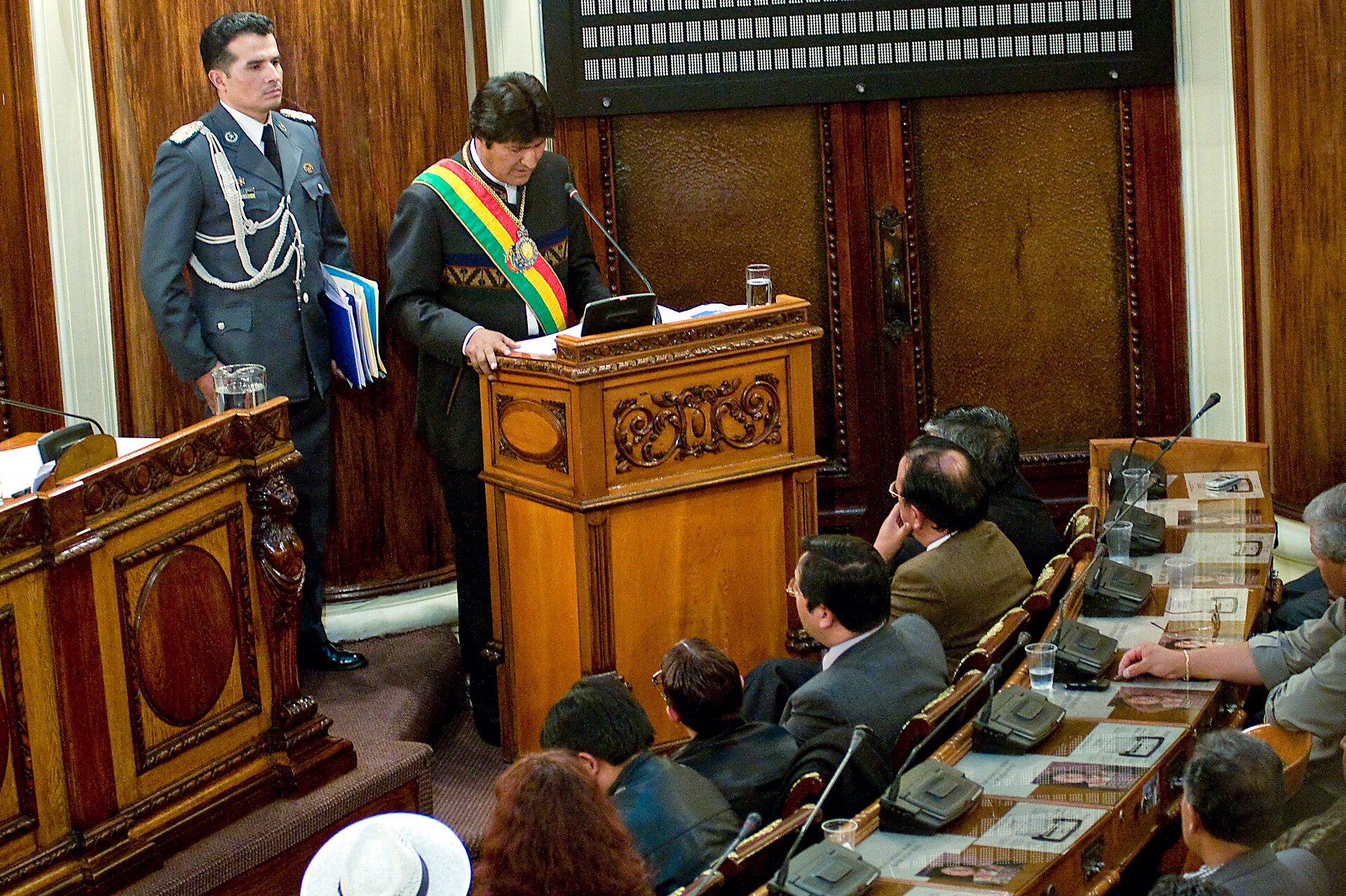
- Feature image: https://en.wikipedia.org/wiki/File:Bolivia_evo-morales_government_Joel_Alvarez.jpg
- Morales suspended operations of the U.S. Drug Enforcement Administration and expelled the U.S. ambassador in 2008, measures that reflected his broader effort to assert national control over drug policy. Rather than treating all coca cultivation as illegitimate, his government recognized coca’s cultural and economic significance and permitted limited legal production while relying on community enforcement, monitoring systems, and development initiatives to reduce excess cultivation. This approach was associated with declining coca cultivation, reduced conflict in coca-growing regions, and greater assertion of Bolivian sovereignty over drug policy. ↩︎
- Central to this vision was sumak kawsay, or buen vivir in Spanish. According to the National Development Plan in Yapu 2009, adopting this alternative worldview involved striving to “live in harmony with nature, to live a social life in solidarity, with a democratic and integral plurinational and diverse development, a multidimensional change departing from cultural diversity and with interculturality and diversity at the basis of the quality of life.” In this sense, Bolivia’s understanding of social justice was expansive and encompassed environmental sustainability, social equality, respect for diversity, inclusive political representation, and an equitable economic system that benefited all citizens rather than prioritizing external economic interests, further departure from the externally imposed 1994 reform. ↩︎
- This vision was reinforced during the 1952 National Revolution, which sought to integrate Indigenous populations through cultural assimilation, particularly via Spanish-language education. Although the revolutionary government incorporated rural unions into its political structure, this inclusion functioned as a mechanism of control, given that decision-making authority remained concentrated at the national level. That this incorporation was partly a response to largely Indigenous revolutionary mobilization in the countryside, which the government struggled to contain, further suggests that it served to bring these movements under greater state control. Likewise, during military rule between 1964 and 1982, alliances with rural communities often depended on the co-optation of local leaders into state-controlled structures, which reinforced centralized authority. ↩︎
- As these tensions between decolonizing discourse and centralized state practices became increasingly difficult to reconcile, the political force of decolonization itself appeared to weaken. Although Morales-era reforms produced meaningful reconfiguration, their limited translation into structural transformation led what initially functioned as a transformative and mobilizing discourse to be perceived as symbolic or as serving to maintain state legitimacy rather than advance more substantive change. Moreover, growing perceptions of corruption and clientelism further eroded the credibility of the state’s transformative claims. Scandals such as the misuse of funds from the Fondo Indígena intended for community projects, alongside widespread beliefs that political loyalty shaped access to resources and opportunities, contributed to the view that the state was consolidating power rather than redistributing it equitably. As a result, social movements that once served as the foundation of the government’s legitimacy increasingly appeared dependent on, rather than autonomous from, state structures. ↩︎